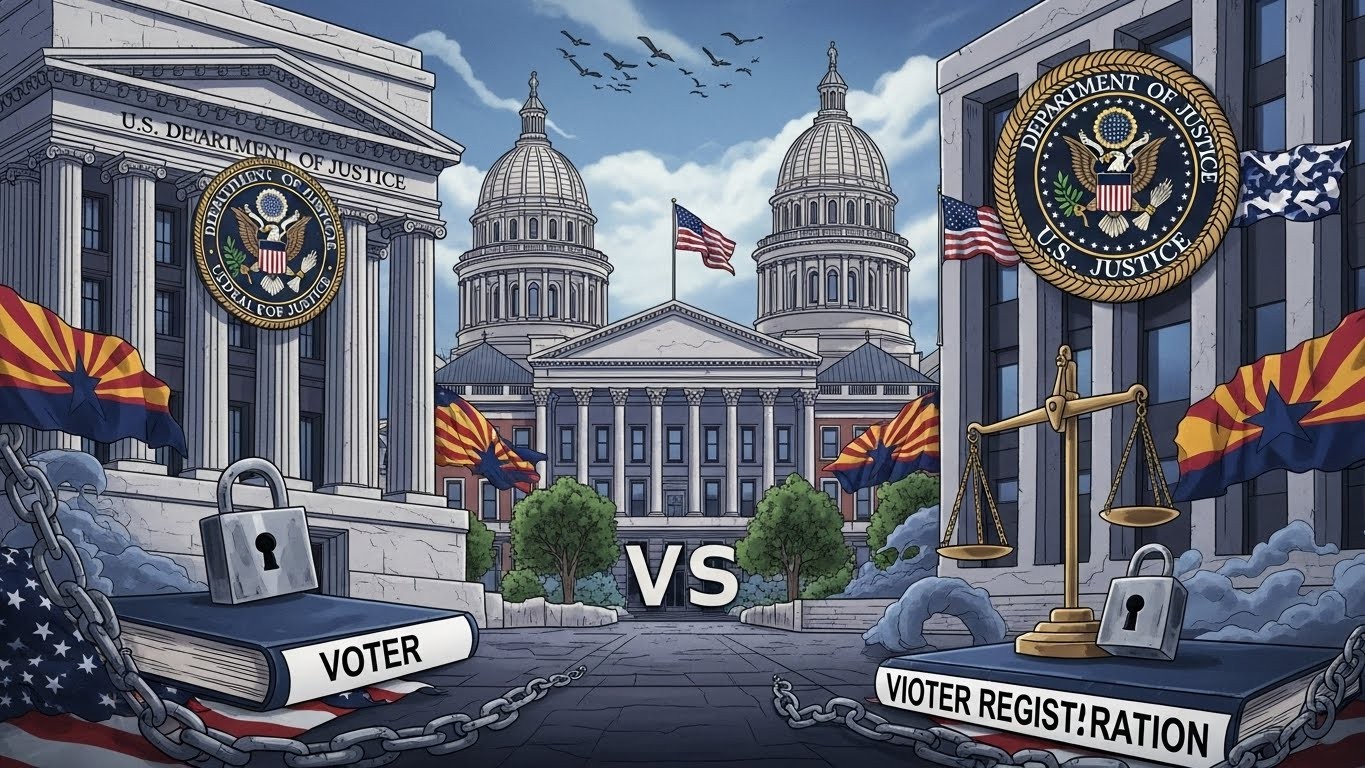
A federal judge has ruled that the Trump administration acted unlawfully when it demanded states hand over their voter rolls so federal officials could cross-check them against an immigration database, striking down a nationwide audit plan just weeks before the November midterm elections, Al Jazeera reports. The 78-page decision by US District Judge Sparkle Sooknanan in Washington is the most significant legal setback yet for the White House's effort to insert the federal government into election administration.
Sooknanan accused the Justice Department of attempting to subvert the very civil rights laws it is meant to enforce, describing a plan that would run "roughshod over longstanding laws that were carefully crafted to protect the rights of the American people." Her ruling halts the department's sweeping project to obtain non-public data and audit nearly every state's voter rolls, and bars it from building a national database containing sensitive voter information such as birthdates and Social Security numbers.
Table of Contents
- A "startling" reversal of the division's mission
- The SAVE database at the centre of the dispute
- A broader legal wall against the data demands
- What happens next
- Frequently Asked Questions
- Sources
- Related from Chronicle
A "startling" reversal of the division's mission
The opinion dwells at length on the transformation of the Justice Department's Civil Rights Division under Trump's second term. Sooknanan, who once served as the division's principal deputy assistant attorney general and was appointed to the bench by President Joe Biden, traced the office's history back to its creation under President Dwight Eisenhower to enforce the Civil Rights Act of 1957, calling it the department's "crown jewel" and noting that generations of its lawyers stood "at the forefront of the federal government's efforts to protect Americans' right to vote."
Against that record, she wrote, "this case is anomalous." Since Trump returned to the White House last year, the department abandoned several high-profile voting-rights cases while political appointees pushed out career staff. For the past year, the public work of the division's voting section has been dominated by obtaining state voter rolls in a hunt for non-citizen voters — a fixation tied to Trump's long-standing, evidence-poor claims of mass election fraud.
Sooknanan singled out what she called the department's "startling arguments": that laws written to guarantee minority voters can exercise their constitutional rights also grant the federal government power to remove them from the rolls. As Democracy Docket reported, she wrote that DOJ attorneys were effectively suggesting "every American citizen who registers to vote is the subject of a voter fraud investigation" simply for registering.
The SAVE database at the centre of the dispute
At the heart of the case was SAVE, the federal immigration database the department wanted to use to identify voters it deemed ineligible and then instruct states to remove. The judge concluded the administration had downplayed the danger that the system would wrongfully disenfranchise eligible US citizens, despite evidence that SAVE has repeatedly and mistakenly flagged lawful citizens as ineligible, Reuters reported.
In the ruling, Sooknanan vacated a policy she said "has removed United States citizens from the voter rolls in their home states and risks disenfranchising many more — a policy that flies in the face of duly enacted laws designed to protect Americans." That is a stinging rebuke for an administration that has made alleged non-citizen voting a central justification for federal intervention in state-run elections.
It is also worth noting that this is not Sooknanan's first decision on the matter. In a separate case she blocked the administration from using an expanded version of the SAVE database to check voter-roll accuracy; the US Supreme Court has temporarily paused that ruling pending further review.
A broader legal wall against the data demands
The ruling did not arrive in isolation. According to Common Cause, one of the plaintiffs alongside the ACLU, Protect Democracy, and CREW, federal judges in 26 states plus the 6th Circuit have already dismissed the Justice Department's demands for voter data, ruling the agency's attempts to consolidate voter rolls unlawful.
"This is a victory for voters and yet another loss for the Department of Justice," said Common Cause president and CEO Virginia Kase Solomón, urging the administration to stop "desperate attempts to seize voters' private data and take control of our elections."
Plaintiff Ruth Nasrullah of Texas said she had not imagined worrying about her personal information being safe "just for exercising my right to vote," adding that the ruling meant she could head into November's election "with more trust that my data — and my vote — are protected." Another plaintiff, Anthony Nel, described being removed from the rolls as an eligible voter and said the decision protects others from the same fate.
What happens next
With the midterms set for November 3, the ruling removes one of the administration's most aggressive tools for federal oversight of elections at a moment when the battle for Congress is entering its final month. The Justice Department has not yet said whether it will appeal. Given the Supreme Court's temporary pause of Sooknanan's separate SAVE decision, the legal fight over how far the federal government can go in policing state voter rolls is almost certainly headed for further rounds — potentially the highest court in the country.
For now, states keep control of their rolls, and a judge's 78 pages stand between voters' private data and a federal database that was never built to decide who gets to vote.
Frequently Asked Questions
What exactly did the judge rule?
US District Judge Sparkle Sooknanan ruled that the Justice Department violated federal law by demanding that states produce non-public voter data — including birthdates and Social Security numbers — to build a national audit system, and she halted the programme.
What is the SAVE database?
SAVE (Systematic Alien Verification for Entitlements) is a federal immigration database designed to verify immigration status for benefits eligibility. The Trump administration wanted to repurpose an expanded version of it to flag voters for removal from state rolls; critics and courts say it wrongly flags lawful US citizens.
Why does the ruling matter for the midterms?
With congressional elections on November 3, the decision stops a federal voter-roll purge effort weeks before voting and keeps election administration in the states' hands — a major check on the White House's push for federal oversight of elections.
Is this the final word on the dispute?
No. The Justice Department can appeal, and the Supreme Court has already temporarily paused a separate Sooknanan order blocking expanded SAVE use — so the broader fight is likely to continue up the appellate ladder.