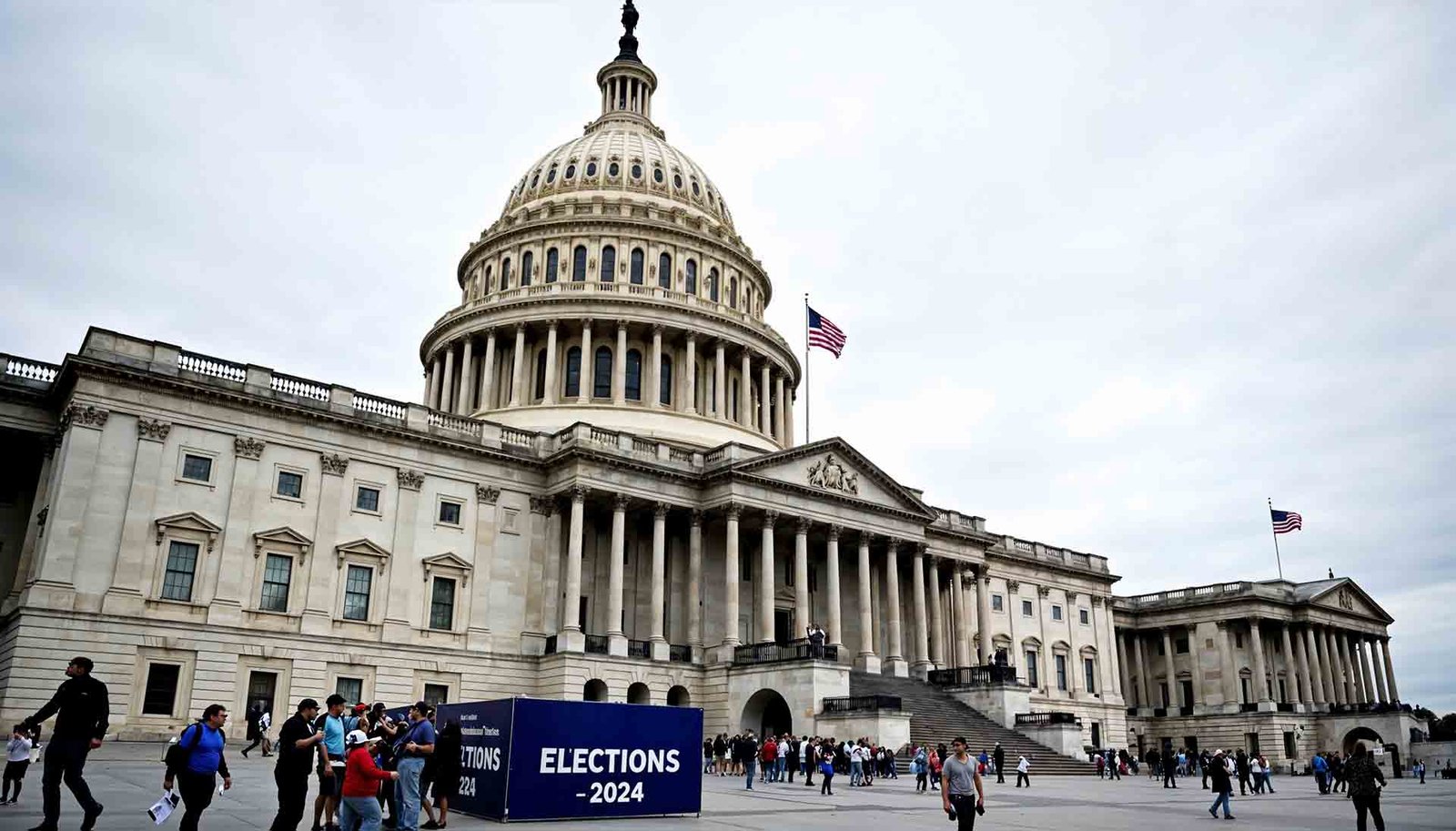
Thirty days before Americans choose a new Congress, the balance of power in Washington is tilting decisively blue. Democrats enter the final month of the 2026 midterms with the House firmly in their sights and the Senate — once written off as a lost cause — suddenly within striking distance, while President Donald Trump campaigns on the weakest approval numbers of his political career. What unfolds between now and November 3 will decide whether the last two years of Trump's second term are defined by legislative momentum or by congressional gridlock and investigation.
Table of Contents
- A president underwater
- The House is slipping away
- The Senate: from pipe dream to battleground
- Money can buy airtime — not affection
- The issues that refuse to move
- The turnout wildcard
- Key takeaways
- Sources
- Further reading
A president underwater
Trump has cast this election as a personal referendum — and by the latest measure, he is losing it. An Associated Press-NORC poll released this week put his approval at 31 percent, the lowest of either of his two terms. Just 26 percent of respondents approved of his handling of the economy, a figure that even dipped below former President Joe Biden's worst showing on the issue.
"Americans are disappointed, bordering on angry that President Trump hasn't delivered on the core promises he made when he won re-election," Henry Olsen, a senior fellow at the conservative Ethics and Public Policy Center, told Al Jazeera.
The president's answer is a relentless final-month blitz. At a Republican Midterm Convention in Dallas, he urged supporters to "vote like I'm on the ballot" and pledged to criss-cross the country for rallies in the closing days. Conservative analysts describe it as a base-turnout play: energising the loyal rather than persuading the undecided. As Olsen put it, "their real problem is persuasion, and it's not something that's going to help with that in the slightest."
The House is slipping away
Election forecasters have long predicted Democrats will reclaim the 435-seat House, and that confidence has only hardened. Both the non-partisan Cook Political Report and the University of Virginia's Sabato's Crystal Ball have moved their assessments in Democrats' direction in recent weeks.
Cook recently shifted 15 House races toward Democrats — converting toss-ups into "leans Democrat" contests and "lean Republican" seats into toss-ups. The firm now projects Democrats will gain 5 to 15 seats, enough to end the Republican majority. One telling shift came in a Texas border district held by Republican Monica De La Cruz, once emblematic of the Latino swing toward Trump in 2024; Cook now rates her race against Democrat Bobby Pulido a pure toss-up.
A Democratic House would hand the party subpoena power and the ability to launch investigations into the administration — a prospect top Democrats have already signalled as a priority, including probes into the Trump family's business dealings.
The Senate: from pipe dream to battleground
If the House looks close to settled, the Senate is where the month's drama will play out. Democrats need a net gain of at least four of the 35 contested seats to take the 100-member chamber — a target dismissed as fanciful a year ago but now, in Kyle Kondik's words at Sabato's Crystal Ball, "within a more comfortable striking distance."
"The trajectory of the polling since Labor Day has generally been that a bad Republican environment is just getting worse," Kondik said, adding that "the Senate just seems to get more and more competitive as the cycle has gone on."
Polling points to a cluster of genuine Republican-held targets: in North Carolina, former Democratic Governor Roy Cooper is expected to comfortably defeat former Republican National Committee chairman Michael Whatley; in Texas, Democrat James Talarico leads Republican Ken Paxton; in Ohio, Democrat Sherrod Brown is ahead of incumbent Senator John Husted; and in Alaska, Democrat Mary Peltola leads Republican Dan Sullivan. Races in Iowa (Ashley Hinson against Josh Turek) and Maine (Susan Collins against Troy Jackson) sit within a single percentage point. Meanwhile Democrats have held steady leads in the Senate seats they currently control in Georgia, New Hampshire and Michigan.
Kondik cautions that polling quality varies and reading the Midwest has been especially difficult for pollsters this cycle — a warning echoed from past elections when survey averages misled.
Money can buy airtime — not affection
If Republicans have one reliable edge, it is cash. This midterm is on course to become the most expensive on record: at least $4 billion had already been spent on gubernatorial and congressional advertising by mid-September, according to the Wesleyan Media Project. A New York Times analysis estimated more than $1 billion of that was "dark money" whose donors are shielded by nonprofits and shell companies.
The Republican National Committee held $125.6 million in cash entering September, dwarfing the Democratic National Committee's $16.9 million — and the DNC carried $17.6 million in debt. Counting the three major committees on each side, Republicans had $233.4 million to Democrats' $130.4 million. AdImpact projects pro-Republican forces will spend $888 million on advertising from mid-September to election day, against $666 million for Democrats, with the GOP advantage particularly pronounced in the key Senate races in Ohio, Texas and Michigan.
Trump himself has pledged $400–500 million from his MAGA Inc super PAC — a threat that could reshape the final stretch if deployed. So far it has spent only about $15 million, most of it on Paxton in Texas, where pro-Paxton ad reservations outpaced Talarico's by roughly $94 million to $30 million in September.
But Democratic strategist Trip Yang argues the money hits a wall of unpopularity: "If you're a little bit handicapped because your president is so toxic, you try to spend your hundreds of millions of dollars attacking the Democrats to make it more of a food fight." The September 23 PBS News/NPR/Marist poll showed independents breaking for Democrats 57 percent to 32 percent — a gap no amount of advertising may close.
The issues that refuse to move
Voters continue to rank the economy first, and the economic backdrop is grim for the incumbent party: consumer confidence recently hit its lowest level since 2014, and gas prices remain elevated amid the fallout from the US-Israel war with Iran. Immigration and corruption also rank high in surveys.
Few of these dynamics are likely to shift before November. Trump has downplayed the prospect of short-term affordability relief and has even signalled a possible escalation with Iran after the vote — hardly the reassurance anxious households want. Lee Miringoff of the Marist Institute of Public Opinion believes "the potential for more than just a marginal shift is there," noting some Democratic candidates have struggled to present a vision beyond opposition to Trump: "The result isn't formed in concrete."
The turnout wildcard
Beyond polls and spending lies a question no forecaster can price: how the vote itself is conducted. Trump has refused to commit to not invoking the Insurrection Act or declaring a state of emergency around the election, remarks rights groups warn could upend turnout.
The pressure is already reshaping the Republican ticket. Several leading Senate candidates have recently put daylight between themselves and the president over the war with Iran — Hinson in Iowa, Husted in Ohio and Mike Rogers in Michigan — while Representative Maria Elvira Salazar criticised Trump's aggressive immigration enforcement as she courts Latino voters in South Florida. Trump responded by reposting a message calling Salazar a "backstabber."
"You need to have something else going for you other than endorsement of Trump," Miringoff said. "Some Republicans are starting to have self-preservation kick in because they're concerned."
Key takeaways
- Democrats enter October favoured to retake the House (projected gain of 5–15 seats) and have dragged the Senate — needing a net gain of four — into genuine contention.
- Trump's 31% approval rating is the lowest of either of his terms, with only 26% approving his handling of the economy.
- Campaign spending is on track for the most expensive midterm in US history, with Republicans holding a substantial cash advantage and Trump sitting on a pledged $400–500 million super PAC war chest.
- Top voter concerns — the economy, gas prices, immigration and corruption — are unlikely to shift before November 3.
- Wildcards remain: Trump's refusal to rule out emergency powers around the vote, and Republican candidates increasingly distancing themselves from his most controversial positions.