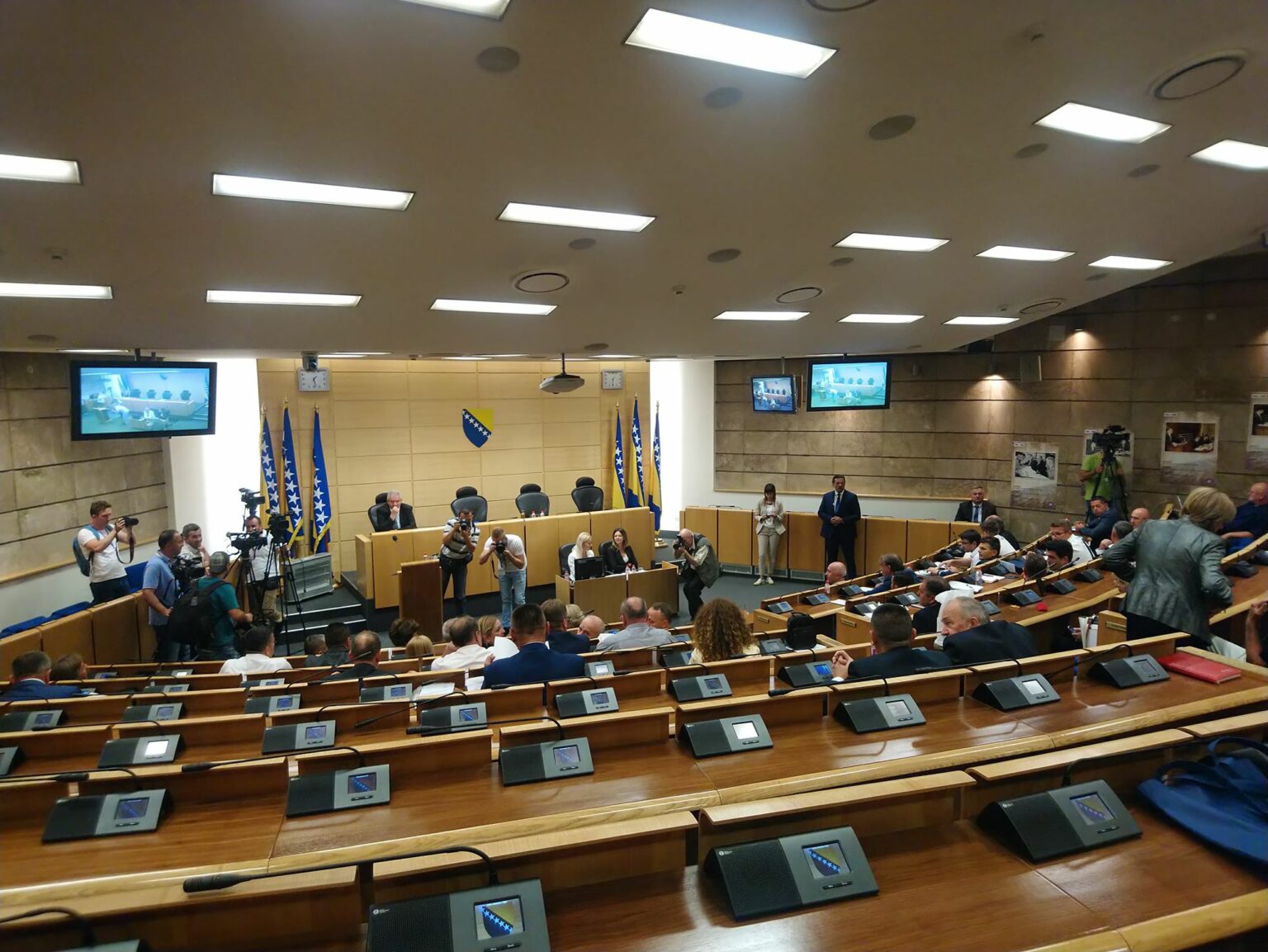
A Bosniak moderate, a pro-Russian Serb nationalist and a Croat nationalist are leading Sunday's election for Bosnia's inter-ethnic tripartite presidency, with Serb separatist leader Milorad Dodik already declaring victory for his camp despite not appearing on the ballot for the first time in nearly 30 years. With more than 90 per cent of polling stations counted, the results point to another government divided along the same ethnic lines that have stalled the country's European Union ambitions for years.
Table of Contents
- The results so far
- Dodik's shadow over the ballot
- A record-low turnout
- The EU question
- Key takeaways
- Sources
- Read more on Chronicle
The results so far
Around 3.4 million voters were eligible to choose the three members of the country's multi-ethnic presidency, the national parliament, and the heads of institutions in the two entities: the Muslim-majority Federation of Bosnia-Herzegovina and the Serb-dominated Republika Srpska.
Based on ballots from more than 90 per cent of polling stations, Bosnia's election commission reported that incumbent Bosniak member Denis Bećirović of the Social Democratic Party was leading his nearest rival, Bakir Izetbegović of the traditionalist Party of Democratic Action, by fewer than three percentage points, Reuters reported. Both newcomer Darijana Filipović of the nationalist Croatian Democratic Union and Bećirović declared victory late on Sunday before the count was complete.
In Republika Srpska, Željka Cvijanović — an existing member of the tripartite presidency from the Serb, pro-Russian nationalist Alliance of Independent Social Democrats (SNSD) — secured a commanding 55.34 per cent of the vote. The Croat member's race went to Filipović with a decisive lead, while projections from the Poliwave tracking platform had largely foreseen the same lineup.
Dodik's shadow over the ballot
The defining figure of the election never stood as a candidate. Milorad Dodik, the long-time Serb separatist leader banned from political office earlier this year, declared victory for his movement on Sunday night — and at his party's final rally on Friday in Banja Luka, he told supporters that Bosnia "is dead".
"It is an impossible country. It doesn't make any sense," Dodik said at the rally, which was also attended by Russian Ambassador Igor Khalabukov, according to the South China Morning Post.
Analyst Dragan Bursać said that despite Dodik not appearing on the ballot for the first time in nearly 30 years, he "is still in command. He is everywhere". The bans imposed on him, Bursać said, "are not working, and he is using them."
The result extends a pattern that has defined Bosnia since the 1995 US-brokered Dayton peace agreement created its web of power-sharing institutions: voters cast ballots along ethnic lines — Muslim Bosniaks, Orthodox Serbs and Catholic Croats — and the winners then block each other's decisions in a weak central government. Read our pre-election coverage of Dodik's Moscow meeting with Putin, where the Russian president promised to send election observers.
A record-low turnout
Bosnia's Central Election Commission said about 1.43 million votes were cast — a turnout of roughly 42 per cent, down about eight points from the 2022 election. Voter frustration has grown over an economic slowdown, the glacial pace of EU entry talks, and a lingering political crisis in which ethnically based dominant parties from the two entities have repeatedly paralysed the central government in Sarajevo.
The EU question
The outcome matters beyond the Balkans. Ethnic divisions have blocked Bosnia's progress toward joining the European Union despite the bloc's efforts to push its divided leaders toward reform. A presidency split between a Bosniak moderate, a pro-Russian Serb nationalist and a Croat nationalist offers little reason to expect that deadlock to break — while Moscow's open presence on the campaign trail underscores how closely Russia is watching.
It was not the only European election this weekend to reward established forces: in Latvia, the pro-Ukraine prime minister was set to retain power, a result covered here.
Key takeaways
- Bosniak moderate Denis Bećirović (SDP-BiH) leads the Bosniak race, narrowly ahead of Bakir Izetbegović (SDA).
- Croat nationalist Darijana Filipović (HDZ BiH) and Serb nationalist Željka Cvijanović (SNSD, 55.34%) are leading their races.
- Milorad Dodik declared victory without being on the ballot, calling Bosnia "an impossible country" at a rally attended by Russia's ambassador.
- Turnout fell to about 42%, down eight points from 2022, amid frustration over the economy and stalled EU talks.
- The results dim hopes of breaking the ethnic deadlock blocking Bosnia's EU bid.