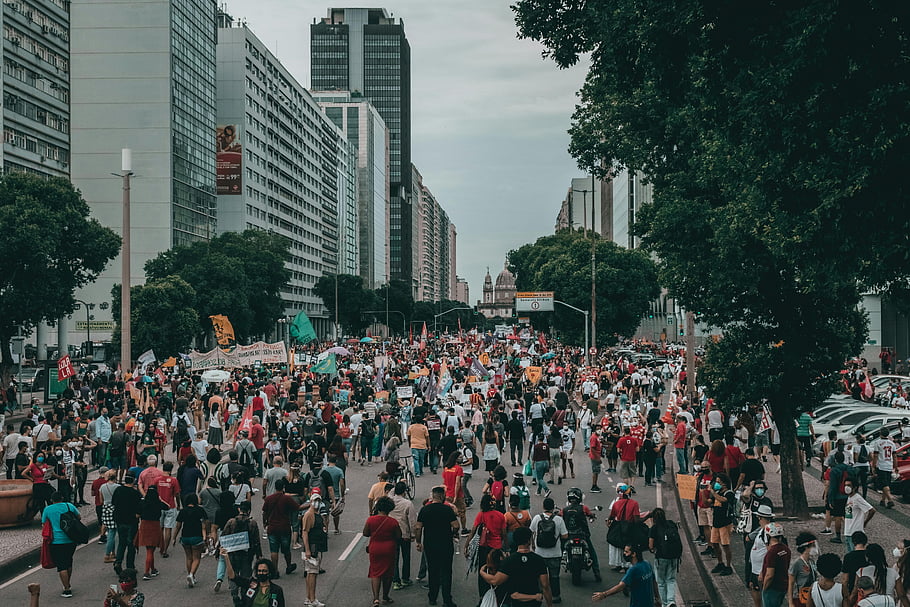
Thousands of people took to the streets of downtown Rio de Janeiro on Wednesday in a student-led march against presidential candidate Flavio Bolsonaro, days after the senator topped Brazil's first-round vote. Wearing stickers that read "Never Again Bolsonaro" and "No to the father, no to the son," demonstrators young and old warned that a far-right victory in the October 25 runoff against President Luiz Inacio Lula da Silva would endanger Brazilian democracy, according to France24.
Table of Contents
- A student march in the heart of Rio
- Why protesters fear a Bolsonarista return
- The political backdrop: runoff on October 25
- Amnesty, the pandemic and the coup legacy
- Frequently Asked Questions
A student march in the heart of Rio
The march wound through downtown Rio de Janeiro amid drums and fireworks, with demonstrators carrying massive flags emblazoned "Get Out Bolsonaro" and posters reading "Dictatorship Never Again." The protest was organized after Flavio Bolsonaro finished first in Sunday's opening round, propelling the far-right senator into a second round against the veteran leftist incumbent Lula, as reported by Arab News.
Among the marchers was Alice Carneiro, a 25-year-old maritime shipping administrator, who said she joined because she believes in democracy — and because she is scared, worried about a possible backlash against her wife, who is trans. She recalled her family's lives being at risk during the pandemic, a period she associates with vaccine denial under the previous Bolsonaro government.
Emmanuel Araujo, 19, who is preparing for university entrance exams, said he found the rise of the far-right in Brazil deeply sad. He argued that much of the Bolsonaro vote is driven not by belief in his proposals but by anti-PT, anti-Lula sentiment — resentment toward Lula's Workers' Party and previous administrations.
Why protesters fear a Bolsonarista return
The marchers' anxiety is rooted in the memory of Jair Bolsonaro's 2019–2022 presidency. The former president is remembered for his handling of the COVID-19 pandemic, which claimed more than 700,000 lives in Brazil — the second-highest death toll in the world after the United States. For Wednesday's demonstrators, that record is inseparable from the Bolsonaro name.
Their fears are also forward-looking. Protesters repeatedly cited Flavio Bolsonaro's plan to grant amnesty to his father, who is currently serving a 27-year prison sentence for attempting a coup after losing the 2022 election to Lula. The younger Bolsonaro, himself a sitting senator, has made the amnesty pledge a centerpiece of his campaign — a prospect that opponents say would erase accountability for one of the most serious assaults on Brazil's democracy since the military dictatorship.
For context on how the first round unfolded, see our coverage of Flavio Bolsonaro's first-round win and the full first-round results.
The political backdrop: runoff on October 25
Brazil's presidential contest is now a two-man race. Flavio Bolsonaro and Lula, who placed second in the first round, will face off in a runoff on October 25. A Quaest poll released in early September showed the two tied at 41 percent each in a potential runoff — an indication of how tightly divided the electorate remains.
The campaign has already reshaped Brazil's public life. On Independence Day, some 28,500 people rallied on Sao Paulo's Paulista Avenue for the conservative cause, in an event organizers framed as a protest against Lula's government and against Supreme Court Justice Alexandre de Moraes, whose prosecution of Jair Bolsonaro made him one of the country's most polarizing figures, as Reuters reported. Wednesday's march in Rio was the left's answer — a show of force meant to signal that the opposition to a Bolsonaro restoration is just as mobilized.
The runoff will also test Lula's political longevity. The 80-year-old president is seeking another term at the head of a country where democratic institutions have spent four years rebuilding after the January 2023 storming of government buildings by Bolsonaro supporters.
Amnesty, the pandemic and the coup legacy
Three threads run through the campaign: amnesty, the pandemic, and the coup attempt. Flavio Bolsonaro's amnesty promise puts the 2022 coup attempt — for which his father received a 27-year sentence — back at the center of the national debate. Supporters frame the conviction as persecution by a politicized Supreme Court; opponents see it as the price of defending constitutional order.
The pandemic legacy cuts the other way. Wednesday's protesters spoke of lost relatives and vaccine denial as lived experience, not history — a reminder that for many Brazilians, the last Bolsonaro presidency is associated with catastrophe rather than nostalgia. Whether that memory moves undecided voters in the final stretch of the campaign is the central question of the runoff.
Frequently Asked Questions
Why did protesters march in Rio de Janeiro on Wednesday?
Thousands joined a student-led march through downtown Rio to protest presidential candidate Flavio Bolsonaro and the surge of the far-right, three days after he finished first in Brazil's presidential first round. Demonstrators said they feared a Bolsonaro victory in the October 25 runoff would threaten democracy.
Who is Flavio Bolsonaro?
Flavio Bolsonaro is a Brazilian senator and the son of former far-right president Jair Bolsonaro. He is the leading candidate of Brazil's far-right and has pledged to grant amnesty to his father, who is serving a 27-year sentence for attempting a coup after the 2022 election.
When is Brazil's presidential runoff?
The second round between Flavio Bolsonaro and President Luiz Inacio Lula da Silva will be held on October 25, 2026. Early polling has shown the two candidates closely tied.
What do protesters want from the runoff?
Wednesday's marchers urged voters to reject a Bolsonarista return, citing the pandemic death toll under Jair Bolsonaro's presidency, fears of democratic backsliding, and opposition to the proposed amnesty for those convicted over the 2022 coup attempt.