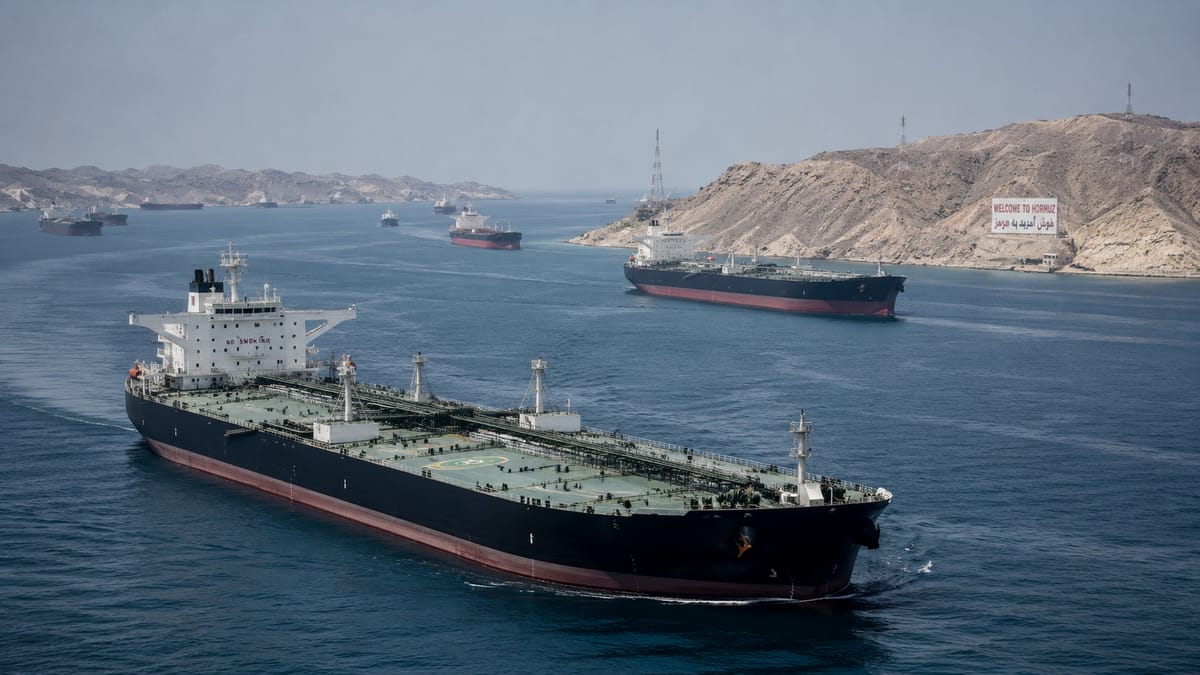
Iran's Islamic Revolutionary Guard Corps (IRGC) says three oil tankers caught fire after striking naval mines east of the Strait of Hormuz on the evening of Wednesday, November 18, in the latest incident in a waterway that has become one of the most dangerous shipping lanes on earth. The Guard alleges the vessels were sailing through restricted waters with their navigation systems switched off and had ignored warnings from Iranian naval forces — but it named no ship, gave no casualty figures, and the claim could not be independently verified. (NDTV)
The statement, carried by Iran's state broadcaster IRIB, also delivered a blunt instruction to the shipping industry: passage through the strategic waterway "must be coordinated with Iranian authorities." It is the clearest sign yet that Tehran intends to treat the strait not merely as a contested sea lane, but as a corridor it claims the right to police — a position no other government has accepted.
What Iran claims happened
According to the IRGC statement, the three tankers were operating in areas Iran describes as off-limits to shipping, having switched off the tracking and identification systems that normally broadcast a vessel's position, course and identity to other ships and coastal authorities. The resulting fires disabled all three tankers, according to a separate statement from Iran's conventional army, also carried by state media.
The two Iranian statements differ slightly in attribution — one speaks for the Guard's navy, the other for the army — but agree on the core account: mines, fire, and vessels that had, in Tehran's telling, brought the danger on themselves by sailing dark through a prohibited zone. Neither statement provided the names, flags, owners or cargoes of the vessels, and no shipowner, flag state or insurer had stepped forward by early Thursday to say one of its hulls had been hit. (ASEAN Now)
Neither the United Kingdom Maritime Trade Operations centre nor United States Central Command had commented on the announcement at the time of publication — a silence that matters, because both bodies have been the usual independent check on Iranian claims in the strait.
The verification gap
That silence is the central problem with Wednesday evening's claim. In a week of competing statements, the gap between what Tehran says and what anyone else can confirm has become the story itself. The IRGC claimed on Monday that mines had damaged six oil tankers since Sunday — a figure US Central Command has previously disputed. Wednesday's claim of three more follows the same pattern: dramatic, specific about the number of ships, and entirely without the identifying details that would let anyone check it.
What is on the record, and independently confirmed, is a separate incident on the same day: the UK Maritime Trade Operations centre confirmed that an ADNOC vessel was struck in the strait, with one crew member missing and 11 injured. That attack is documented; the evening claim of three burning tankers is not — at least not yet. (Read more)
The distinction matters for more than accuracy. Every unverified claim still moves insurance premiums, freight rates and oil prices, because the market cannot wait for proof when tankers are burning. And every disputed claim still hardens the political positions on both sides, because each camp cites the other's statements as evidence of bad faith.
A week of incidents, a pattern of escalation
Wednesday's claim did not arrive alone. It caps a week in which the strait has produced a near-daily drumbeat of reported attacks. On Monday, Iranian naval forces said three oil tankers struck mines and caught fire in separate incidents — one in an area east of the strait the army described as prohibited, and two more, according to the Guard's navy, while attempting to cross the southern passage. Two days earlier, six tankers were reported hit over a single weekend, including a supertanker that sank. (Read more)
The tempo, the timing and the language all point in the same direction. The incidents cluster around moments of diplomatic failure — Wednesday's claim came the day after talks in Muscat collapsed — and each Iranian statement pairs the incident report with a rule: coordinate with Tehran, stay out of the restricted zones, or accept the risk. That is less the language of a navy reporting accidents than of a government using a mine campaign as diplomatic coercion, with a calendar attached.
The context is a war that has now run for nine months. Since fighting between the United States, Israel and Iran erupted in February, Tehran has restricted navigation through the strait and attacked ships it says do not comply. The conflict has already spread well beyond the waterway: American strikes hit an Iranian missile site on Qeshm Island this week, Iran has attacked US bases in Kuwait and Bahrain in response, and Houthi forces in Yemen have struck Saudi infrastructure in coordination with Tehran. (Read more)
Why the world cannot look away
The Strait of Hormuz carries about a fifth of the world's seaborne oil, and there is no practical alternative route for most of the crude that flows through it. When mines appear in its eastern approaches, the consequences are immediate and global: war-risk insurance for vessels transiting the strait has soared, shipping companies are rerouting or demanding hazard pay for crews, and every new incident adds a risk premium to the price of a barrel.
For the Gulf states, the stakes are more direct still. Their economies depend on the strait, their ports sit within range of the same weapons, and several of them host American bases that have already been targeted in this war. They have spent the week urging restraint in public while preparing for escalation in private — a posture that grows harder to sustain with each new claim of a burning tanker.
For the shipping industry, the practical question is now unavoidable: whether to treat Iran's "coordinate with us" demand as a rule to follow, a threat to defy, or a bluff to test. No major shipping company has said publicly that it will seek Tehran's permission to transit an international waterway, and doing so would amount to accepting a blockade by another name. But sailing on without it means accepting that the next vessel through the eastern approaches could be the next one on fire.
What to watch next
Three things will determine whether Wednesday's claim fades into the fog of this war or marks a further escalation. First, whether any vessel is identified — a named ship with a flag, an owner and a crew turns a claim into an incident with legal and diplomatic consequences. Second, whether UKMTO or US Central Command confirms or contradicts the Iranian account, as they have done with earlier claims. And third, whether oil markets and insurers treat this as another unverified statement or as evidence that the mine campaign east of Hormuz is now a standing condition of passage.
Until those answers arrive, the strait's new reality is plain enough: the world's most important oil chokepoint is now a place where tankers sail dark, where mines are laid in waters no one will publicly map, and where the difference between an accident and an act of war depends on whose statement you believe.
Frequently Asked Questions
What did Iran claim happened east of the Strait of Hormuz on November 18?
Iran's Revolutionary Guard said three oil tankers caught fire after striking naval mines east of the strait on the evening of November 18. It alleged the vessels were sailing through restricted areas with their navigation systems switched off and had ignored warnings from Iranian naval forces.
Has the claim been independently verified?
No. Iran did not name the vessels, and neither the UK Maritime Trade Operations centre nor US Central Command had commented on the announcement. By contrast, a separate attack the same day on an ADNOC vessel was confirmed by UKMTO, with one crew member missing and 11 injured.
Why does the Strait of Hormuz matter so much?
About a fifth of the world's seaborne oil passes through the strait, which narrows to 21 miles at its tightest point. There is no practical alternative route for most Gulf crude, so any threat to shipping there immediately affects global oil prices, insurance costs and energy security.
What is the wider context of these incidents?
The incidents come during a war between the United States, Israel and Iran that began in February 2026. Iran has restricted navigation through the strait since the war erupted and has attacked ships it says do not comply, while the US has struck Iranian targets including a missile site on Qeshm Island.