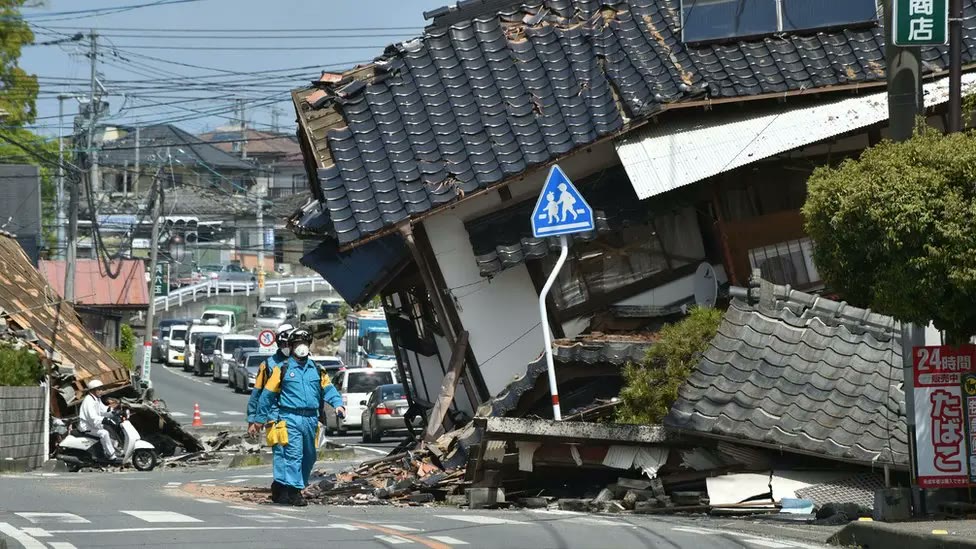
A magnitude 5.7 earthquake struck Kumamoto Prefecture in southwestern Japan early on Thursday, injuring two people, damaging several homes and forcing the suspension of bullet-train services, in the strongest shaking the region has felt since a magnitude 7.1 quake killed more than 30 people there in July. (Kyodo News)
The Japan Meteorological Agency (JMA) said the tremor hit at 2:22 a.m. local time, with its epicentre in the Amakusa-Ashikita area of the prefecture at a depth of about 10 kilometres. No tsunami warning was issued, and the agency said there was no tsunami threat.
Table of Contents
- How strong was the shaking?
- Injuries, evacuations and transport disruption
- A week of aftershock warnings
- The shadow of the July 28 quake
- A prime minister briefed from abroad
- Understanding Japan's intensity scale
How strong was the shaking?
The quake registered lower 5 on Japan's seven-point seismic intensity scale — known as shindo — in the city of Minamata, the hardest-hit area. Intensity 4 was recorded in Yatsushiro in Kumamoto, in the city of Miyazaki, capital of neighbouring Miyazaki Prefecture, and in Izumi in Kagoshima Prefecture. (Jiji Press)
The shaking was felt across the southwestern main island of Kyushu as well as in parts of the islands of Shikoku and Honshu, according to the agency. A series of aftershocks with an intensity of 1 or higher followed the main tremor. (Kyodo News)
Seismologists believe the quake occurred as a fault in the Earth's crust moved sideways, and it is thought to be part of the seismic activity associated with the massive earthquake that hit Kumamoto on July 28. (The Japan Times)
Injuries, evacuations and transport disruption
Authorities said two people were injured in the quake, and several homes were damaged. The municipal governments of Minamata and Kuma issued evacuation orders for residents in the worst-affected areas, a precaution taken while officials checked buildings for structural damage. (Kyodo News)
The disruption spread quickly to transport. Eight Kyushu shinkansen bullet trains running between Hakata and Kagoshima-chuo stations were suspended, affecting around 5,600 passengers, according to operator JR Kyushu. Services were halted for safety inspections of tracks and overhead lines, a standard procedure after strong shaking in Japan.
The relatively low casualty count, despite shaking strong enough to damage homes, reflects both the quake's moderate magnitude and the strict building standards that Japan applies in earthquake-prone regions. Similar-sized tremors elsewhere in the world have caused far heavier damage, but Japanese homes and infrastructure are engineered to absorb seismic energy.
A week of aftershock warnings
The Japan Meteorological Agency urged residents in areas that experienced strong shaking to remain alert for further quakes of up to around lower 5 or more powerful for about a week. (Jiji Press)
The warning matters because aftershock sequences can be unpredictable: buildings weakened by the first shock are more vulnerable to a second, and landslides can follow in hilly terrain after heavy shaking. Residents were advised to check for cracked walls, gas leaks and unstable furniture, and to keep emergency supplies within reach.
Thursday's quake was the first to register lower 5 on the intensity scale in Kumamoto Prefecture since August 1, according to the agency — a measure of how quiet the aftershock sequence had become before this latest jolt.
The shadow of the July 28 quake
Thursday's tremor cannot be understood without the disaster that preceded it. On July 28, Kumamoto was struck by a magnitude 7.1 earthquake that registered the maximum 7 on the intensity scale in parts of the prefecture and killed more than 30 people. (Kyodo News)
That quake destroyed buildings across the region — including in Yatsushiro, where homes were flattened — and left a long recovery still under way. International aid flowed in, with Taiwan donating funds to support reconstruction, and many residents were still living in temporary housing or repairing damaged homes when Thursday's quake struck.
The link between the two events is geological, not coincidental: Thursday's quake is believed to be part of the same fault system activity set in motion by the July disaster. For residents, the psychological impact may be as significant as the physical one — a reminder that the ground beneath their rebuilt lives is still settling.
Japan sits on the Pacific Ring of Fire, and Kumamoto's recent history underlines the point. The prefecture was also devastated by a pair of powerful quakes in April 2016, which killed 50 people and caused widespread damage. The region's repeated battering has made it a test case for Japan's disaster-preparedness systems, from early-warning broadcasts to evacuation drills.
The pattern of strong quakes in Japan this autumn has been notable: a magnitude 6.1 earthquake struck off the Tokyo coast earlier in November, and a magnitude 6.6 quake hit the Banda Sea near Indonesia — a reminder that the wider Pacific rim remains seismically active.
A prime minister briefed from abroad
Prime Minister Sanae Takaichi, who is visiting China for the Asia-Pacific Economic Cooperation (APEC) forum summit, said on social media that she had been briefed on the tremor and had instructed relevant agencies to grasp the situation and provide appropriate information to the public. (Kyodo News)
The timing placed Japan's leader thousands of kilometres from the disaster zone at the moment it struck, but the government's disaster-response machinery — coordinated through the Cabinet Office and the JMA — activated immediately, with local authorities issuing evacuation orders within hours.
Understanding Japan's intensity scale
International readers often confuse magnitude with intensity. Magnitude measures the energy released at the quake's source — in this case 5.7. The shindo scale, by contrast, measures how strongly the shaking is actually felt at a given place, from 0 to 7.
A lower 5 on the shindo scale means most people are frightened and find it difficult to move, unsecured furniture may topple, and some walls can crack. It is the fifth-highest level on the scale, and the threshold at which damage to buildings becomes a real possibility. Thursday's quake reached that level in Minamata — strong enough to injure two people and damage homes, but below the upper 6 and 7 levels that cause widespread destruction, as seen in July.
For now, Kumamoto's residents are watching and waiting. The JMA's one-week warning window will test whether Thursday's quake was the last significant aftershock of the July disaster — or a sign that the fault system beneath the prefecture has more to release.
Frequently Asked Questions
When and where did the earthquake strike?
The magnitude 5.7 earthquake hit Kumamoto Prefecture in southwestern Japan at 2:22 a.m. local time on Thursday, November 19, 2026, with its epicentre in the Amakusa-Ashikita area at a depth of about 10 kilometres, according to the Japan Meteorological Agency.
How many people were injured?
Two people were injured and several homes were damaged, according to authorities. Evacuation orders were issued in the cities of Minamata and Kuma, and eight Kyushu shinkansen bullet trains were suspended, affecting around 5,600 passengers.
Was there a tsunami warning?
No. The Japan Meteorological Agency said there was no tsunami threat and issued no tsunami warning after the quake.
Is this quake related to the July earthquake in Kumamoto?
Yes, seismologists believe it is part of the seismic activity associated with the magnitude 7.1 earthquake that struck Kumamoto on July 28, 2026, killing more than 30 people. It was the first quake to register lower 5 on Japan's intensity scale in the prefecture since August 1.
How long will the aftershock risk last?
The Japan Meteorological Agency has urged residents in areas that experienced strong shaking to remain alert for further quakes of up to around lower 5 or more powerful for about a week.