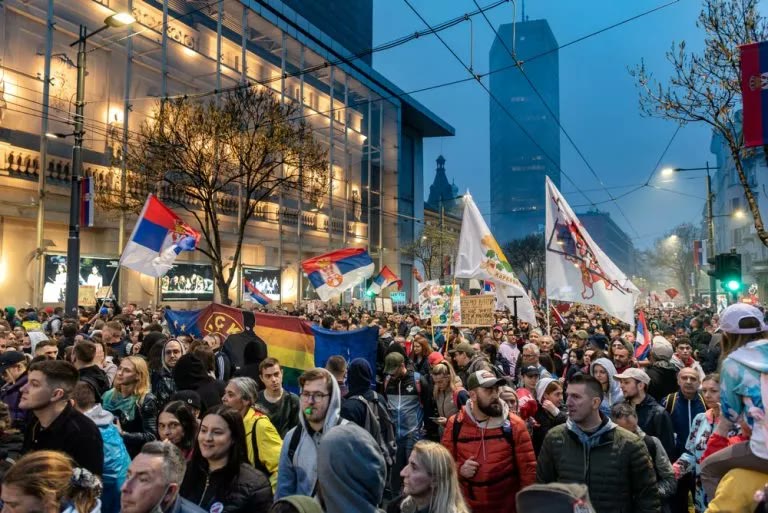
Dozens of protesters entered the Belgrade newsroom of Informer TV on Monday evening, October 26, 2026, interrupting a live broadcast to confront its editor-in-chief, as tens of thousands of people took to the streets for a second night of celebrations after the student-led movement's historic election victory over Aleksandar Vucic. The incident, broadcast live by the station itself, has become the first flashpoint of Serbia's post-Vucic era — a test of whether a movement born in protest can now govern with restraint.
Live footage showed around 30 people walking into the newsroom and surrounding editor-in-chief and owner Dragan Vucicevic. Some shouted "This is how it is in free Serbia!" and "Where is Vucic now?", while others called for Vucicevic's arrest, according to Reuters. After brief clashes with police, the crowd dispersed. Among those who entered the building was the mother of one of the 16 victims of the Novi Sad railway station collapse, the tragedy that ignited the student movement, Newslaundry reported, citing AFP.
Table of Contents
- A newsroom interrupted on live television
- Vucic's response: an attack on free speech
- The student movement calls for calm
- Why Informer became a symbol
- A journalists' association seeks licence revocation
- The wider reckoning with Vucic-era media
- Key takeaways
- Frequently Asked Questions
- Sources
- Chronicle related reading
A newsroom interrupted on live television
The confrontation unfolded on Monday evening, less than 24 hours after Vucic conceded defeat in Sunday's snap parliamentary election. The Student List, born out of the student-led anti-corruption protest movement, defeated Vucic's alliance with around 53 per cent of the vote to 39 per cent, on a near-record turnout of almost 70 per cent, according to Serbia's election commission figures cited by the BBC.
In the footage, Vucicevic is filmed by protesters as they demand that he apologise to what one man called "his free Serbian people." The scene was chaotic but brief: police intervened, and the group left the building without, so far, any reported serious injuries. The station's own cameras captured the entire episode, and clips spread rapidly across social media — a fitting irony for a broadcaster long accused of shaping the narrative in Vucic's favour.
Vucic's response: an attack on free speech
Vucic, who resigned the presidency to run for prime minister and conceded less than two hours after polls closed on Sunday, responded on his personal Instagram account. Wearing a jumper emblazoned with the crossed-out word "sorry," he called the incident an attack on free speech and the freedom of journalism, according to Al Jazeera.
The charge carries a particular sting. Vucic, who served as information minister under Slobodan Milosevic in the 1990s and went on to dominate Serbian politics for 14 years, was himself repeatedly accused by journalists' groups and European monitors of maintaining tight control over the media during his rule. His defenders argue that the storming of a newsroom — whatever the station's editorial line — crosses a line that a democratic transition should not cross. His critics reply that the same concern was rarely heard from his camp while pro-government outlets targeted protesters.
The student movement calls for calm
The student movement moved quickly to distance itself from the incident. Ilija Srdanovic, the cardiologist who headed the Student List's election slate and is the leading candidate to become prime minister, urged supporters to remain peaceful. "We ask of you to stay calm and dignified until the end of the electoral process, just like you have been until now," he said in a video posted on his Instagram account. "Don't resort to any form of violence. Your Student List and your student movement urge you on this."
The appeal matters because the movement has no single clear leader and is still working out who will fill the key government posts. Its credibility rests on the discipline that carried it from campus protests to an election landslide; scenes of a newsroom being stormed risk undermining the very contrast with the old order that won it votes. Srdanovic's message was, in effect, a first act of governance: setting the tone before taking office.
Why Informer became a symbol
For months, pro-government outlets such as Informer cast protesting students as dangerous actors conspiring to destabilise Serbia. The tabloid and its television arm were among the loudest voices warning that the movement was a foreign-backed plot — a line Vucic's Serbian Progressive Party repeated throughout the campaign. On Sunday, those students won.
That history explains why Informer's newsroom, rather than any other building in Belgrade, became the focus of Monday night's anger. For many protesters, the station was not merely a broadcaster but an instrument of the system they had just voted out: a symbol of the media landscape under Vucic, in which loyalist outlets enjoyed access and advertising while critical voices were squeezed. The mother of a Novi Sad victim entering the building gave the episode a personal dimension that no political speech could match.
A journalists' association seeks licence revocation
The institutional response came swiftly. The Independent Association of Journalists of Serbia said it would submit an application on Tuesday to have Informer TV's broadcasting licence revoked, citing systematic violations of law and programme obligations, Reuters reported.
The application, if pursued, will test Serbia's regulatory machinery in a new political context. A licence revocation driven by a journalists' association, processed through the proper regulator, would look very different from a newsroom stormed by a crowd — but critics of the old order will watch closely to see whether the new government respects due process, or simply replaces one form of media pressure with another. European institutions, which have long criticised Serbia's media environment, are likely to scrutinise the case closely.
The wider reckoning with Vucic-era media
The Informer episode is only the opening chapter of a broader reckoning. Serbia's media landscape was profoundly shaped by 14 years of Vucic's rule: ownership structures, advertising flows, regulatory appointments and the working conditions of journalists all bear his imprint. Unwinding that legacy without resorting to the same tools — pressure, intimidation, politically motivated licensing decisions — will be one of the new government's hardest tasks.
There is also a question of what the victorious movement itself wants from the media. A student movement that grew up documenting protests on phones and social media has a instinctive understanding of free expression; whether it extends that understanding to outlets that opposed it will define Serbia's democratic transition as surely as any cabinet appointment. Monday night's events suggest the public mood is still raw. The leadership's response suggests it knows the stakes.
For now, the celebrations continue — brass bands on the streets of Belgrade, balloons in the shape of the Student List's number 3, and a country still absorbing the scale of what changed on Sunday. But the Informer newsroom intrusion is a reminder that revolutions, even electoral ones, have a second act, and it is rarely as tidy as the first.
Key takeaways
- Around 30 protesters entered Informer TV's Belgrade newsroom on Monday evening, interrupting a live broadcast and confronting editor Dragan Vucicevic.
- The incident came during a second night of celebrations after the Student List's historic election win over Aleksandar Vucic, with 53 per cent of the vote.
- Vucic called the storming an attack on free speech; the student movement's leading figure, Ilija Srdanovic, urged supporters to stay calm and avoid violence.
- The Independent Association of Journalists of Serbia plans to apply to revoke Informer TV's broadcasting licence, citing systematic legal violations.
- The episode opens a wider debate about how Serbia's new government will handle the media landscape shaped by 14 years of Vucic's rule.
Frequently Asked Questions
What happened at Informer TV in Belgrade?
On the evening of Monday, October 26, 2026, around 30 protesters entered the newsroom of Informer TV, a broadcaster supportive of former leader Aleksandar Vucic, interrupting a live programme and confronting editor-in-chief Dragan Vucicevic. Some called for his arrest; after brief clashes with police, the crowd dispersed.
Why did protesters target Informer TV?
Informer, a pro-government tabloid and television network, spent months portraying the student protesters as dangerous actors plotting to destabilise Serbia. After the students' movement won Sunday's election, the station became a symbol of the Vucic-era media landscape for many demonstrators.
How did Vucic respond?
On his personal Instagram account, Vucic described the incident as an attack on free speech and the freedom of journalism. He had conceded defeat in the snap parliamentary election less than two hours after polls closed on Sunday.
What did the student movement say?
Ilija Srdanovic, the cardiologist who led the Student List's election slate, urged supporters to stay calm and dignified and to avoid any form of violence until the electoral process is complete.
Will Informer TV lose its licence?
The Independent Association of Journalists of Serbia said it would apply on Tuesday to have Informer TV's broadcasting licence revoked, citing systematic violations of law and programme obligations. Any decision would go through Serbia's media regulator.