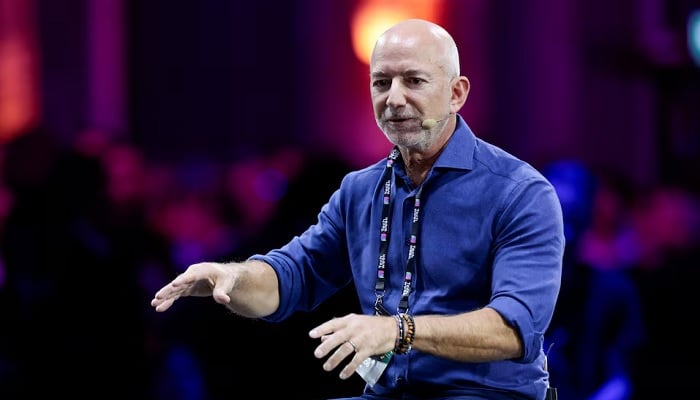
What if artificial intelligence let you support your family working only three days a week? Amazon founder Jeff Bezos thinks it could. In a wide-ranging interview that aired on Fox News' "Special Report" on 7 October, Bezos predicted that AI-driven productivity gains — in the double digits across the economy — could give workers a choice many can only dream of: fewer hours, or a household that runs on a single income. "Some people will also decide, you know what? I can support my family by working three days a week," he told host Bret Baier. "That's what productivity in the economy means."
The interview, filmed on the factory floor of Bezos' rocket company Blue Origin in Cape Canaveral, Florida, covered AI, space and the economy. But it was the labour-market prediction that travelled furthest. According to Fast Company, Bezos' central argument is a contrarian one: his main worry is not that AI destroys jobs, but that it creates a labour shortage — because once people can afford to work less, many will choose to.
From job losses to labour shortages
Bezos' logic runs like this. If AI makes each worker dramatically more productive, the economy can produce the same output with fewer hours of human effort. Rather than mass unemployment, he believes workers will use the surplus to buy back their time: dropping second jobs, moving to four- or three-day weeks, or choosing single-earner households. "It's going to actually be difficult to hire people," he said, "because the productivity in the economy is going to make it so that if people don't want to work two jobs, they won't have to."
It is a strikingly optimistic reading of the AI moment, and it stands apart from the anxiety dominating much of the industry. The same week, Microsoft CEO Satya Nadella called for an "emergency brake" on advanced AI systems — a reminder, which we covered earlier this week, that not every tech leader shares Bezos' sunny view. Where Nadella sees containment, Bezos sees abundance.
Economists, however, are likely to raise an eyebrow at the leap from productivity to prosperity. Historically, productivity gains do not automatically flow to workers — the share of US economic output going to wages has drifted down for decades even as productivity rose. Whether AI's gains translate into shorter weeks or simply fatter margins is a political and institutional question, not a technological one. Bezos offered no timeline and no mechanism; the prediction rests on the assumption that markets will pass the surplus to workers.
The awkward context: 30,000 Amazon jobs gone
There is an elephant in the studio. Baier pressed Bezos on Amazon's recent mass layoffs: roughly 30,000 corporate roles eliminated across two waves in October 2025 and January 2026 — the largest workforce reduction in the company's history. None of those workers got a shorter week; they got severance.
Bezos' defence was that Amazon had substantially expanded its workforce during the COVID-19 pandemic and was now correcting an overshoot. He framed the cuts as a post-pandemic reset rather than an AI-driven purge. But the timing is uncomfortable: his company is cutting tens of thousands of corporate jobs while its founder predicts AI will soon let everyone work less. Critics will read the interview as optimism for everyone except the people Amazon already let go.
The tension is not unique to Amazon. Across the tech industry, companies are pouring hundreds of billions into AI infrastructure — Samsung just posted a record quarterly profit on the back of the AI chip boom — while simultaneously trimming white-collar headcount. The industry's message to investors is efficiency; its message to the public is liberation. Squaring those two messages is the rhetorical challenge of the AI era, and Bezos just attempted it on camera.
Prometheus, orbital data centres and "light-touch" regulation
Beyond the labour prediction, the interview offered a window into Bezos' current obsessions. He described Prometheus, the AI startup he co-leads, which aims to build an "artificial general engineer" — tools, he said, "so easy to use that anyone will be able to be an engineer," turning ideas into physical products.
He also revived one of his long-standing themes: moving heavy industry — and now data centres — off the planet. He said there is "good reason" to build data centres in space, noting that Blue Origin has requested permission to launch more than 50,000 satellites that would serve as "orbital data centres." It is a characteristically Bezos-scale answer to the energy and land-use concerns surrounding AI infrastructure.
On regulation, he urged a light hand while the technology is young, arguing rules should target harmful uses rather than the technology itself. "You don't want to regulate knives," he said. "You want to regulate murder." It is a line that will please the industry — and alarm those who believe, with Nadella, that advanced systems need guardrails before, not after, deployment.
Asked whether AI is in an investment bubble, Bezos said it is "very hard to know" — but added that "the inventions don't disappear when the bubble pops." It is a veteran dot-com-era observation: the infrastructure built in a frenzy tends to outlast the frenzy itself.
Why this prediction matters — and why to be sceptical
Bezos is not the first tech titan to forecast a leisure dividend from automation; Keynes promised his grandchildren a 15-hour week in 1930. What makes this iteration interesting is the framing: not post-work utopia, but a labour market where workers gain bargaining power because they can afford to walk away. If true, it would flip the standard AI-anxiety narrative on its head.
But the sceptical case is strong. The three-day week assumes productivity gains are shared — through wages, hours regulation or some mechanism Bezos did not name. It assumes workers who "choose" to work less can actually afford to, rather than being pushed into precarious gig work. And it assumes employers, handed dramatically more productive workers, will respond by hiring fewer people at the same pay rather than simply producing more with fewer people. None of these follows automatically from better models.
For now, the prediction joins a growing stack of competing AI futures: Nadella's emergency brake, the industry's efficiency drive, and Bezos' three-day week. Which one arrives depends less on the technology than on who gets to decide what productivity is for.
Frequently Asked Questions
What exactly did Jeff Bezos say about the three-day work week?
In an interview with Fox News' Bret Baier that aired on 7 October 2026, Bezos said AI could generate double-digit productivity gains across the economy, allowing some people to support their families working three days a week — or on a single household income. He argued the result could be a labour shortage, not mass unemployment.
Why does Bezos think AI will cause a labour shortage instead of job losses?
His argument is that productivity gains let workers buy back their time: dropping second jobs, working fewer days, or choosing single-earner households. If enough people work less, employers will find it "difficult to hire people," in his words.
How does this square with Amazon's 30,000 job cuts?
Awkwardly. Amazon eliminated about 30,000 corporate roles in October 2025 and January 2026, its largest-ever workforce reduction. Bezos said the cuts corrected pandemic-era over-hiring; critics note the laid-off workers got severance, not shorter weeks.
What is Prometheus, the startup Bezos mentioned?
Prometheus is an AI startup Bezos co-leads, aiming to build an "artificial general engineer" — tools simple enough that anyone could use them to turn ideas into physical products.
What did Bezos say about AI regulation?
He urged a "light hand" while the technology is new, arguing regulation should target harmful uses rather than the underlying technology: "You don't want to regulate knives. You want to regulate murder."