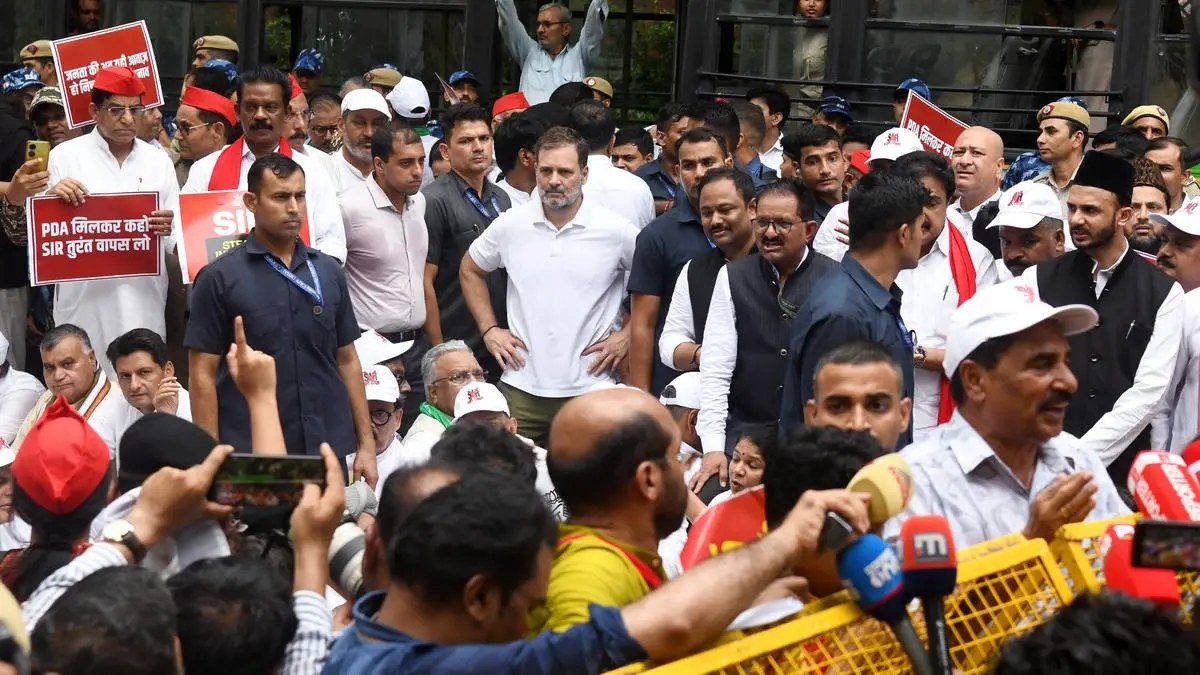
Hundreds of security personnel fanned out across central New Delhi on Tuesday, sealing roads around the Election Commission's headquarters with barricades as opposition lawmakers prepared to march from parliament to demand the resignation of India's election chief over a controversial revision of voter rolls.
The march, organised by the opposition INDIA bloc, was set for 11 a.m. local time, with MPs instructed to assemble at Makar Dwar, the parliament's main gate, half an hour earlier. Television footage showed officers in riot gear posted outside the barricaded Nirvachan Sadan office, close to parliament and the seat of government, as authorities advised residents to avoid the area and shut off several routes, Reuters reported.
The march and who leads it
Congress MP Jairam Ramesh announced the plan on Monday evening after a two-hour strategy session of the party's state leadership, attended by Congress president Mallikarjun Kharge and Leader of Opposition in the Lok Sabha Rahul Gandhi. According to The News Mill, Ramesh said lawmakers from all opposition parties would walk together in a peaceful demonstration to the Commission's door, part of a week-long "Save Democracy" campaign running from October 2 to 8.
The confrontation has been building for weeks. Opposition leaders accuse Chief Election Commissioner Gyanesh Kumar of overseeing a Special Intensive Revision (SIR) of electoral rolls that, they allege, has quietly deleted millions of legitimate voters — and that the exercise benefits Prime Minister Narendra Modi's ruling Bharatiya Janata Party. Both the Commission and the BJP have rejected the accusations, insisting the revision is a routine cleanup.
Tuesday's march caps a series of almost daily demonstrations by student groups, political parties and a youth movement that has joined the street campaign, which began last week. The protests continued even as police maintained restrictions on public gatherings in the capital.
Weekend unrest in Delhi and Mumbai
The march follows an unruly weekend. On Sunday, thousands of protesters took to the streets in New Delhi and Mumbai demanding Kumar's resignation, with police detaining demonstrators for a third consecutive day, according to reporting by the International Business Times. Witnesses described protesters breaching barricades in the capital, surrounding vehicles carrying detainees and lying on the road to block their movement. This newsroom covered the third day of those protests earlier this week.
In Mumbai, the Shiv Sena (UBT) and the Maharashtra Navnirman Sena led a joint march of thousands, headed by Uddhav Thackeray and Raj Thackeray. Addressing the crowd, Raj Thackeray called the SIR process "totally illegal", demanded electronic voting machines be discarded in favour of ballot papers, and insisted that "people will decide who will sit in power, not the ECI", Deccan Herald reported.
What is the SIR dispute about?
The Special Intensive Revision is a nationwide exercise launched by the poll body to update electoral rolls, launched last year. The Commission says it removes duplicates, deceased voters and non-residents — standard maintenance anywhere with a large electorate.
Critics counter that the process has been rushed, opaque and inconsistently applied. Opposition parties point to cases where entire neighbourhoods lost voters from the rolls, and to a report in the Indian Express last month describing internal divisions within the poll body over the lists and registration procedures. Those reported differences, the opposition argues, raise doubts about the Commission's neutrality. Kumar himself has not commented publicly on the row.
The stakes are the franchise itself: India has more than 980 million registered voters, and even small errors in a revision propagate into questions about legitimacy in a country where national elections turn on thin margins in dozens of seats.
The courts weigh in
India's Supreme Court agreed on Monday to hear legal arguments seeking intervention in the accusations against the poll body's voter drive and the conduct of its chief. At the hearing, the bench told petitioners that if any decisions were found against the law, "we will take care of it" — a signal, however guarded, that the judiciary is watching.
The opposition has also promised five nationwide rallies to inform voters about what Kharge has called "vote chori" (vote theft), and a large public meeting in Delhi on November 1. At the bloc's September 30 meeting, leaders additionally demanded that ballot papers replace electronic voting machines.
Frequently Asked Questions
Why are opposition MPs marching to the Election Commission?
They want Chief Election Commissioner Gyanesh Kumar removed, accusing him of conducting a biased voter-roll revision that allegedly removed millions of legitimate voters and tilted the field toward the ruling BJP. The Commission and the BJP deny the charge.
What is the Special Intensive Revision (SIR)?
It is the Election Commission's nationwide exercise to update electoral rolls. The poll body calls it routine maintenance; the opposition says it has been rushed and opaque, with inconsistent application that disenfranchised genuine voters.
How did the government and the Commission respond?
The Election Commission and the BJP have denied all accusations of bias, describing the revision as a legitimate administrative exercise. The commissioner himself has not commented on the row.
Has the matter reached the courts?
Yes. India's Supreme Court agreed on October 5 to hear petitions seeking its intervention in the accusations against the voter drive and the commissioner's conduct, promising to act if any decisions are found unlawful.
Is this an isolated protest?
No. It is the latest in weeks of street demonstrations — including large marches in Mumbai and Delhi over the weekend and near-daily protests by youth and student groups — under the opposition's "Save Democracy" campaign running October 2 to 8.
Sources: Reuters, The Hindu, Deccan Herald, The News Mill.