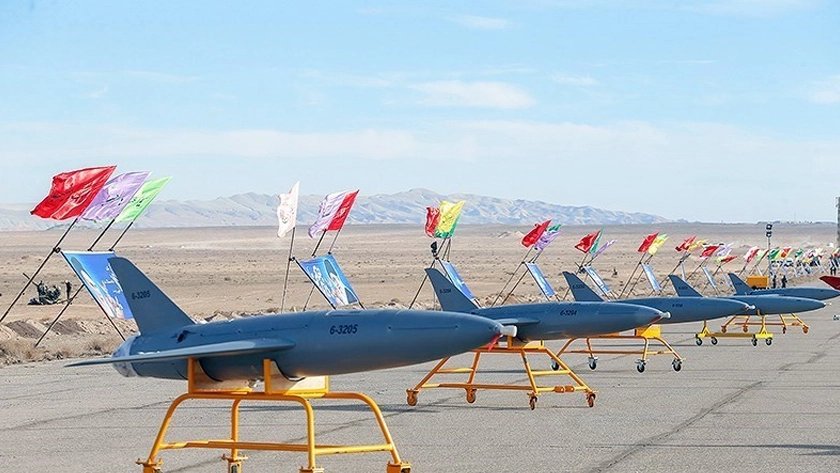
Iran's army has unveiled an upgraded version of its Arash long-range attack drone, claiming a warhead doubled from 50 to 100 kilograms and navigation designed to keep hitting targets even when GPS signals are jammed. The unveiling, built around the first-ever footage released from inside an underground drone production facility, came as Army Commander-in-Chief Major General Amir Hatami declared that Iran was fully prepared for "any type of warfare."
What was unveiled
The showcase centres on an evolution of the Arash family of one-way attack drones — kamikaze weapons that fly a programmed route to a target and destroy themselves on impact. According to Iran's Fars news agency, the footage was broadcast by state broadcaster IRIB and shows the production of long-range suicide attack drones at an underground weapons manufacturing facility hidden in a mountainous area, with dozens of completed aircraft stored in the tunnels. Vietnam.vn
Iranian military statements describe three main upgrades: the warhead increased from 50 kilograms to 100 kilograms; a new navigation system, reportedly assisted by artificial intelligence, that maintains accuracy when an adversary uses electronic warfare or jams satellite navigation; and a jet-powered variant of the Arash currently under development, which would substantially increase its speed and ability to penetrate air defences. Defence Security Asia
General Hatami has also promised a further revelation: the name and technical specifications of a separate, entirely new unmanned aerial vehicle will be presented officially in the near future. Aravot
The underground message
The choice of venue was itself the point. Hatami toured the facility on camera and stated that the armed forces are continuing to expand their underground manufacturing sites to produce the equipment they need. The footage is meant to answer a specific claim Iran's enemies have made repeatedly: that recent rounds of fighting degraded its production capacity. Hatami said the opposite — that production did not decline during the war, that facilities were expanded, and that significant reserves were maintained. Dunya News
Analysts reading the presentation note the caveats: the available material offers no independently verified output figures or delivery schedules, and the Iranian descriptions do not explain which sensors the AI-assisted navigation uses, how they interact, or whether the guidance claims apply to one variant or the whole family. Defence Security Asia
Hatami's warning
The tone of the unveiling was not technical but strategic. Hatami said the Iranian army had achieved "significant maturity" in drone technology and claimed that during previous fighting Iran deployed weapons that surprised its adversaries and inflicted heavy losses. He added that the country was in a stronger position in terms of both the quality and quantity of its military capabilities in preparation for a potential conflict, and that Iranian forces were familiar with their adversaries' strategies.
He also signalled the direction of Iranian doctrine: the use of drones, unmanned naval vessels and small aircraft is expanding, underscoring a bet that unmanned and low-cost systems are the future of the country's warfighting.
Why now
The timing is difficult to miss. The unveiling lands in the middle of one of the most volatile periods in the region this year: Iran is embroiled in a standoff over the Strait of Hormuz, where it has laid out conditions for reopening the waterway while trading threats with Washington, a story Chronicle has followed as attacks on tankers continued through October.
Across the Atlantic, US officials have warned of a possible American attack on Iran even as President Trump publicly ruled out strikes before the midterms — a position he has reversed and re-reversed more than once this month. Tehran has also expanded surveillance in the Gulf of Oman and east of the Strait of Hormuz.
In that context, the Arash announcement reads as deterrence theatre: a signal that the country's strike capacity not only survived the war but grew in the middle of it.
Frequently Asked Questions
What is the Arash drone?
The Arash is Iran's family of long-range one-way attack drones — kamikaze weapons that fly to a fixed target and detonate on arrival. Earlier versions have been supplied to proxies and allies in the region, and the Arash-2 has been among the most-deployed variants. The upgrade revealed this week centres on a heavier 100-kilogram warhead and GPS-independent guidance.
What does GPS-free guidance mean in practice?
Iran claims the upgraded drone can keep striking accurately even when satellite navigation signals are jammed or spoofed — a common countermeasure on modern battlefields. Iranian descriptions credit artificial intelligence for the improvement, though no independent technical details, sensor lists or test results have been published.
Why did Iran unveil it now?
The announcement comes amid acute tensions with the United States and Israel, a standoff over the Strait of Hormuz, and repeated American warnings about a possible attack on Iran. Showcasing hardened underground production is a deliberate deterrent signal: that Iran's long-range strike capacity survived the recent fighting and is still growing.
Are the claimed improvements verified?
No. The footage and specifications come from Iranian state media and military statements. Independent analysts note there are no verified production numbers, no confirmation of which sensor package the new navigation uses, and no public damage assessments to establish what a 100-kilogram warhead would change in practice.
What else is Iran developing?
According to the statements this week: a jet-powered variant of the Arash with greater speed, AI-assisted targeting upgrades, an expanding role for unmanned naval vessels and small aircraft, and an entirely new UAV whose name and specifications Hatami promised to reveal soon.
Sources: Dunya News • Defence Security Asia • Vietnam.vn • Aravot (via TASS)