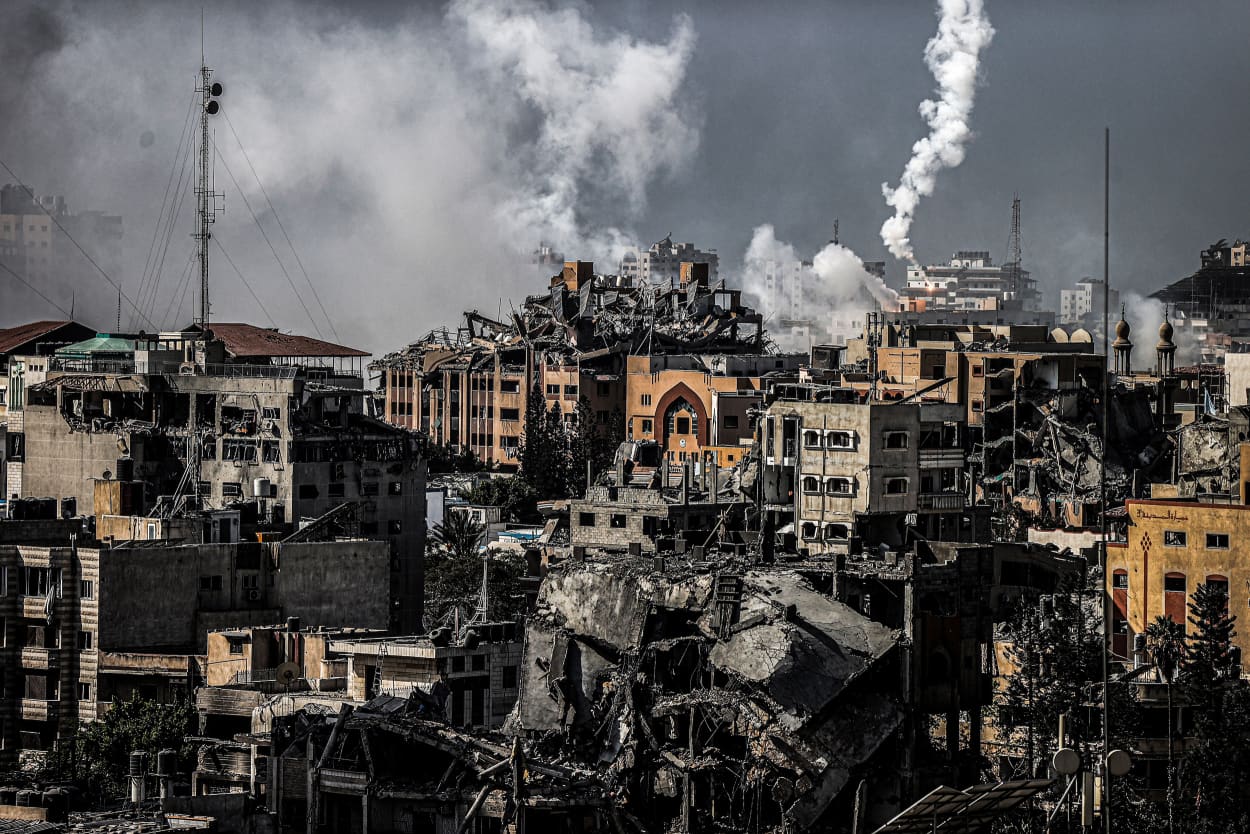
Israeli tanks rolled across the Yellow Line into Hamas-controlled central Gaza on Wednesday, in the first broad ground offensive since the ceasefire of October 2025. Three Palestinians were killed, families fled refugee camps in Nuseirat and Bureij, and Gaza's main north-south highway was shut — a day that put the year-old truce under its heaviest strain yet.
The operation began in the morning, with Israeli armour advancing near Salah al-Din Street, east of the Nuseirat refugee camp and north of Bureij. Witnesses said tanks drove onto the Salah al-Din road itself, Gaza's main north-south artery, for the first time since the ceasefire took hold. Al Jazeera
What the military says — and what happened on the ground
The Israeli military described the action as a "precise operation" west of the Yellow Line, aimed at removing a threat to its troops and dismantling Hamas infrastructure. Israel's Coordinator of Government Activities in the Territories (COGAT) told residents of three designated blocks — 660, 661 and 666, around Bureij and Nuseirat — to leave for the duration of the operation, and said the Salah al-Din road would be closed in the area. Khaleej Times
Hospital officials reported three Palestinians killed in the first hours: one in an airstrike on the town of al-Mughraqa, north of Nuseirat, which also wounded several people, and others in separate drone strikes near Nuseirat, in Gaza City and outside a police station in Deir el-Balah, according to Gaza's civil defence agency. Gaza's Health Ministry said seven people had been killed and 15 wounded across the Strip in the previous 24 hours.
Al Jazeera correspondents in Gaza reported that no evacuation order had been issued before the operation was announced — only a statement that the military would destroy infrastructure in the area. Families packed what they could carry and left on foot, many of them already displaced several times over the course of the war.
A line drawn by the ceasefire
The Yellow Line is the boundary established under the ceasefire agreement signed between Israel and Hamas in October 2025. It separates the more than 60 percent of Gaza that Israel says it controls from the Hamas-administered areas to the west. Until Wednesday, Israeli ground forces had not crossed it in a large-scale operation since the truce began, even as airstrikes continued through the year. Chronicle
That context is what makes this operation different from the regular strikes of recent months. The ceasefire halted major fighting but never stopped Israeli attacks, and it never secured Hamas's disarmament — the two unresolved questions at its core. The truce has now lasted more than a year, and as Chronicle reported on its anniversary, more than 1,450 Palestinians were killed in Israeli operations in its first year alone, while most of its long-term promises — reconstruction, a stable governing arrangement, the full flow of aid — remained unfulfilled.
A truce under pressure from both sides
The ground operation landed on the same day that the US-backed body overseeing the truce accused both Israel and Hamas of failing to meet their commitments to end hostilities, according to a 12-page report seen by Reuters. The timing underlines how fragile the arrangement has become: neither side, the monitors found, has delivered what the deal required of it. SRN News
Hamas condemned Wednesday's operation as a violation of the ceasefire, warning that evacuation orders for residents of northeastern Nuseirat would displace thousands of people and deepen the humanitarian crisis. The warning carries weight in a territory where the displaced already live in tents and damaged buildings: as Chronicle reported this month, recent flooding has destroyed shelters across Gaza, leaving families exposed as winter approaches.
In a separate development on Wednesday, the Erez crossing in northern Gaza reopened for truck inspections for the first time since February 2025. Trucks will not enter Gaza there; instead they will travel under military escort to the Kerem Shalom crossing in the south.
Politics in Israel, diplomacy in the region
The operation also comes at a delicate political moment in Israel. Parliamentary elections ended inconclusively, and opposition leader Gadi Eisenkot is trying to form a government without caretaker Prime Minister Benjamin Netanyahu, who has built his political brand on guaranteeing Israel's security. Any escalation in Gaza now plays directly into that contest over who can be trusted with the country's defence.
Israeli military sources, quoted by the Jerusalem Post, said there were no plans for an expansive invasion for the foreseeable future — a signal that the operation is intended to stay limited, at least for now. The US Central Command chief, Admiral Brad Cooper, met Israeli military officials in Israel on Wednesday, a reminder that Washington is watching the escalation closely.
What happens next
The immediate question is whether the operation ends quickly, as the military's language suggests, or becomes the start of a wider push. The truce has survived a year of strikes, disputes and unmet promises, but it has never before faced a ground crossing of the line that defines it. If Israeli forces withdraw after destroying the infrastructure they targeted, the ceasefire may hold in its battered form. If they stay, or if Hamas responds with force, the agreement that was supposed to end the war could unravel in the camps of central Gaza.
For the families who fled Nuseirat and Bureij on Wednesday, the distinction is academic. They are displaced again, in a territory where there is barely anywhere left to go.
Frequently Asked Questions
What is the Yellow Line in Gaza?
The Yellow Line is the boundary drawn under the October 2025 ceasefire agreement between Israel and Hamas. It separates the area Israel controls — more than 60 percent of the Gaza Strip — from the Hamas-administered areas to the west.
Why did Israel launch the operation on November 18, 2026?
The Israeli military said it was a "precise operation" to remove a threat to its troops and destroy Hamas infrastructure west of the Yellow Line, in the Bureij and Nuseirat area of central Gaza.
How many people were killed?
Hospital officials and Gaza's civil defence agency reported three Palestinians killed in the first hours of the operation, with several more wounded. Gaza's Health Ministry said seven people had been killed across the Strip in the previous 24 hours.
Is the October 2025 ceasefire still in force?
Formally, yes — but it has been under severe strain. The US-backed body overseeing the truce accused both Israel and Hamas on Wednesday of failing to meet their commitments, and this is the first broad Israeli ground operation across the Yellow Line since the ceasefire began.
What did Hamas say about the operation?
Hamas condemned it as a violation of the ceasefire, warning that evacuation orders for residents of northeastern Nuseirat refugee camp would displace thousands of people and worsen Gaza's humanitarian crisis.