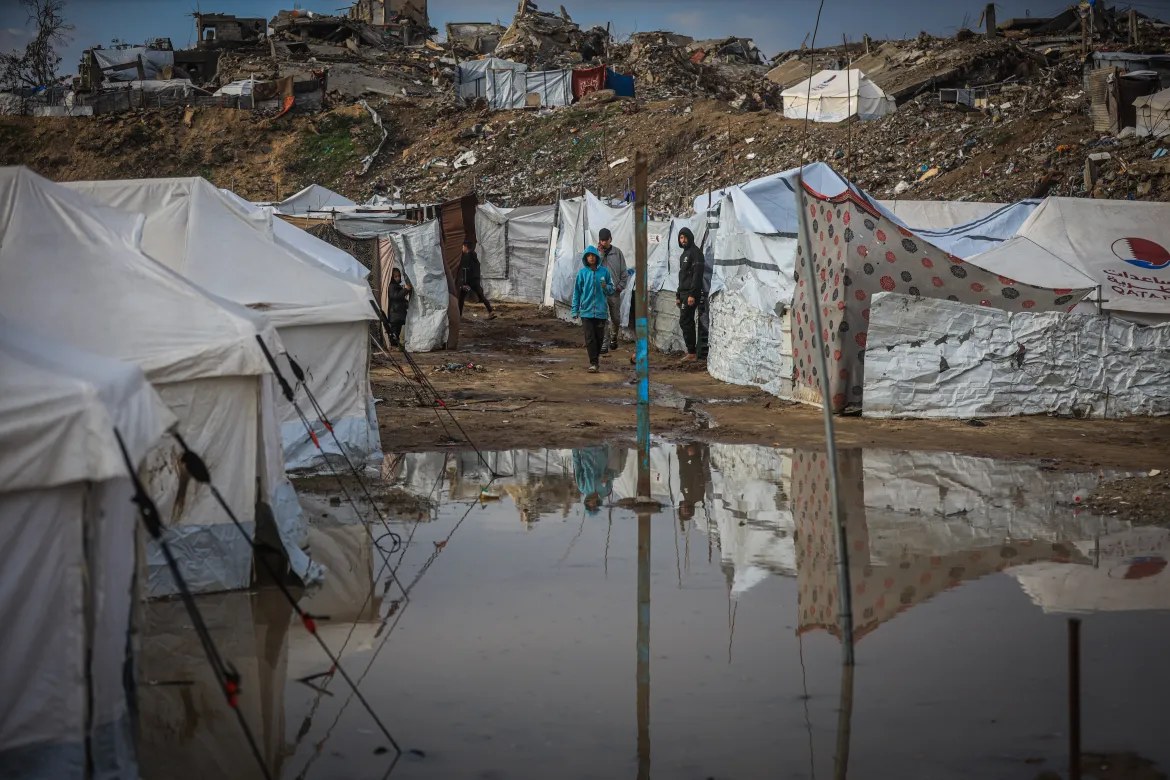
Heavy rain and strong winds sweeping Gaza since late Friday have flooded tens of thousands of tents sheltering displaced Palestinians, stripping families of what little protection they had as winter weather arrives in a territory where most homes lie in ruins (Al Jazeera).
Table of Contents
- A weekend storm overwhelms the camps
- Emergency services stretched to breaking point
- Food and aid cut off as the rain fell
- A winter the shelters were never built to survive
- Frequently Asked Questions
A weekend storm overwhelms the camps
The storm struck from late Friday, bringing hours of driving rain and high winds across the Gaza Strip. According to Gaza's Government Media Office, the flooding swamped 70,000 tents and brought down dozens of walls, while damage from the storm was estimated at $3 million.
Reporting from Gaza City on Sunday, Al Jazeera correspondent Ibrahim al-Khalili described makeshift tents that offered almost no defence against the weather. Families who had spent days reinforcing their shelters watched the rain tear through them within hours. Soaked mattresses, pillows and clothes were left behind as people scrambled to salvage what they could.
"The latest storm exposed just how fragile the protection is. In just a few hours, heavy rains and strong winds tore through shelters families had spent days trying to reinforce," al-Khalili said.
The scale of the exposure is stark. Nearly 400,000 displaced Palestinians are sheltering in locations considered highly vulnerable to further flooding, according to the same reporting — meaning the next storm could leave even more people without a roof of any kind.
Emergency services stretched to breaking point
Gaza's Civil Defence said it received more than 1,500 emergency calls during the storm, as residents reported collapsing structures and rising water in camps across the territory. The agency warned that more than 2,000 buildings are at risk of collapse, and said at least 300,000 tents are needed to provide adequate shelter for displaced people facing the winter weather.
The numbers underline how thin the margin has become. Tents that were always meant as a temporary measure have become the only housing available to hundreds of thousands of people, and each storm tests them beyond what canvas and plastic sheeting can withstand. With reconstruction materials still heavily restricted, there is little prospect of replacing tents with anything more durable in the near term.
The flooding is the latest blow in a humanitarian crisis that has ground on for more than three years. The war that began on 7 October 2023 has devastated homes and infrastructure across Gaza, and continuing restrictions on aid, shelter supplies and reconstruction materials have hampered every relief effort. More than 74,640 people have been killed since the war began, according to figures reported by Al Jazeera, and at least 1,610 Palestinians have been killed since a ceasefire took effect in October 2025.
Food and aid cut off as the rain fell
The storm did not only destroy shelter. Reporting from Deir el-Balah in central Gaza, Al Jazeera's Ashraf Abu Amra said displaced families whose shelters were flooded had not received food aid since early Saturday — leaving them cold, wet and hungry at the same time.
Jonathan Veitch, UNICEF's special representative in Palestine, said the majority of people in Gaza are living in "terrible conditions" and called for more funding to provide urgently needed aid. Relief organisations have struggled for years to bring sufficient supplies into the territory, and the storm has now added a fresh surge of need to a system that was already overwhelmed.
The United Nations had warned before the winter that the risk was coming: in October it cautioned that around 950,000 people in Gaza faced flood risks as the rainy season approached. The weekend's storm has turned that warning into reality, and forecasters expect more rain in the weeks ahead.
A winter the shelters were never built to survive
What makes this flooding different from an ordinary storm is the context in which it landed. Gaza's displaced population is not sheltering in buildings with roofs and drainage; it is living under canvas in crowded camps, many of them on low-lying ground with no sanitation or storm-water systems. When the rain comes, there is nowhere for the water to go except through people's homes.
Aid agencies have been warning for months that winter would be the hardest test yet for a population that has already endured three years of war, displacement and deprivation. The storm that arrived this weekend was not even the worst of the season — it was an early one — and it still destroyed tens of thousands of shelters in a matter of hours.
The immediate question is whether replacement tents, tarpaulins and other shelter materials can reach Gaza fast enough, and in sufficient quantities, before the next storm. The Civil Defence figure of 300,000 tents needed gives a measure of the gap. Until that gap closes, every forecast of rain is a forecast of more families losing the little shelter they have.
Frequently Asked Questions
How many tents were flooded in Gaza this weekend?
Gaza's Government Media Office said heavy rain and strong winds since late Friday flooded 70,000 tents and brought down dozens of walls, with storm damage estimated at $3 million.
How many people are at risk from further flooding?
Nearly 400,000 displaced Palestinians are sheltering in locations considered highly vulnerable to more flooding, and Gaza's Civil Defence says at least 300,000 tents are needed to provide adequate shelter.
What did emergency services report during the storm?
Gaza's Civil Defence said it received at least 1,500 emergency calls, and warned that more than 2,000 buildings are at risk of collapse.
Why is the shelter situation in Gaza so fragile?
Most displaced Palestinians are living in makeshift tents because homes and infrastructure have been devastated by the war that began on 7 October 2023, and restrictions on aid, shelter supplies and reconstruction materials have prevented tents being replaced with more durable housing.
What are aid agencies asking for?
UNICEF's special representative in Palestine, Jonathan Veitch, said most people are living in "terrible conditions" and called for more funding to provide urgently needed aid, while the Civil Defence has appealed for hundreds of thousands of tents.
Related coverage: the UN's warning that 950,000 people in Gaza faced flood risks this winter, our report on the risk of fragile buildings collapsing in Gaza, and one year on, the ceasefire's unfulfilled promises.