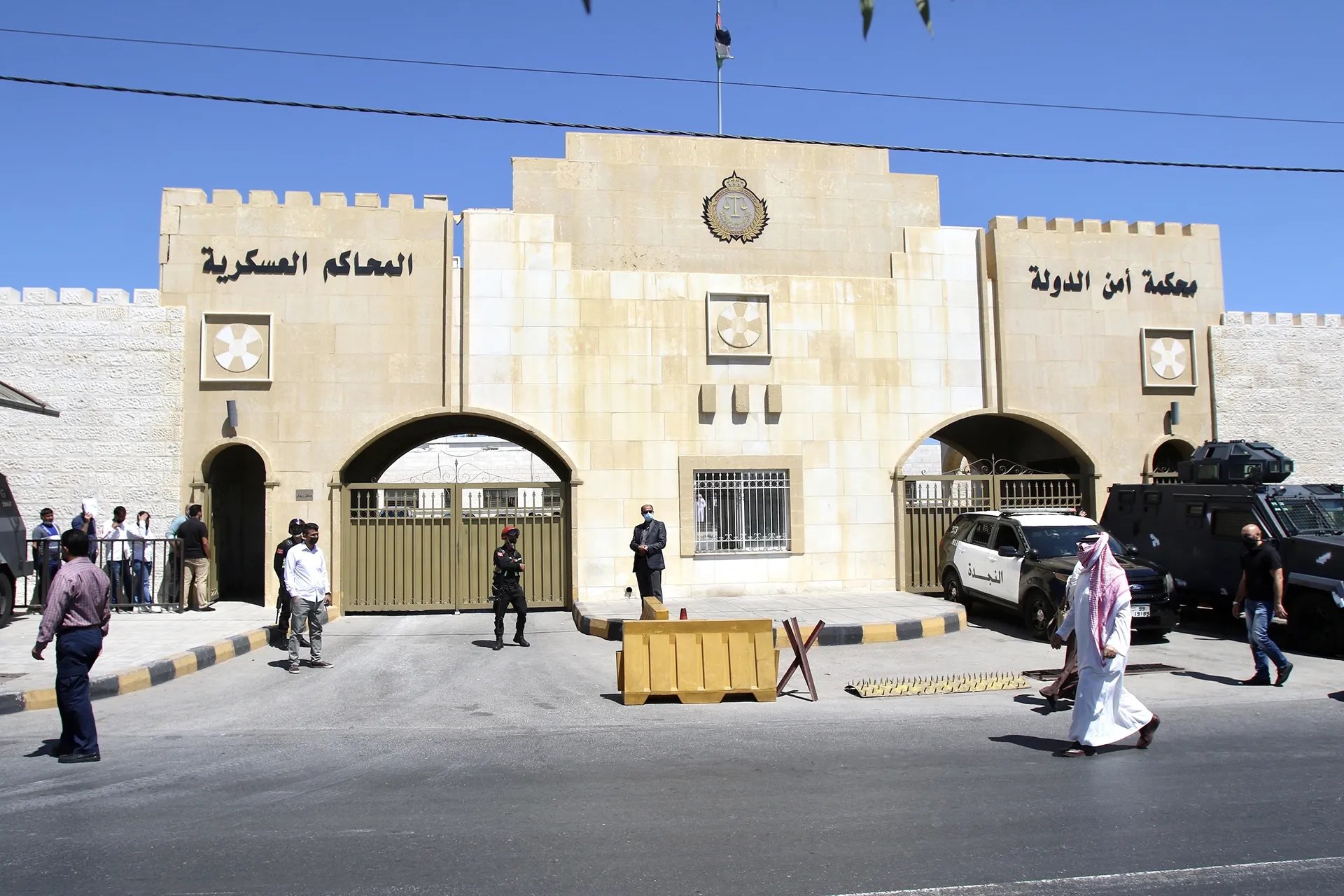
A Jordanian court has sentenced three men to death by hanging for the gun attack on a Greek Orthodox church in the southern governorate of Karak last month that killed nine people and wounded 25 others, in one of the swiftest terrorism verdicts the kingdom has delivered in years.
The State Security Court handed down the sentences on Sunday, November 15, less than a month after gunmen stormed a funeral at St George's Greek Orthodox Church in the village of Hammoud on October 23. The Jordanian military announced the ruling in a statement, saying the court had sentenced to death "the three criminals who carried out the terrorist attack" at the church, Al Jazeera reported.
The three men were convicted of carrying out terrorist acts resulting in death, possessing weapons and ammunition for terrorist purposes, conspiring to commit terrorist acts, and promoting the ideology of a terrorist organisation. The sentences are not yet final: under Jordanian law they are subject to automatic review by the Court of Cassation, and the ruling can still be appealed.
A funeral turned into a massacre
The attack struck during a funeral service at the church in Hammoud, a village in Karak governorate, when gunmen opened fire on mourners gathered inside. Nine people were killed and 25 wounded in what Jordanian officials described as a rare attack on the kingdom's Christian minority — a community that has largely been spared the sectarian violence that has swept the wider region.
Authorities said the three defendants — two Jordanian brothers and a relative by marriage — fled after the shooting and were arrested three days later, on October 26, following a shootout at an abandoned house in Karak. Prosecutors formally charged them with terrorism-related offences on November 3, setting up a trial that moved from charge to verdict in under two weeks.
Two further defendants received six-year prison terms after one of the charges against them was reclassified as a firearms offence, according to counsel for the victims' families. Church bells rang at St George's in Hammoud after the verdict was announced, in a moment of mourning and relief for a community still burying its dead.
Speed, and what it signals
The pace of the proceedings stands out. Jordan's State Security Court, a military tribunal that handles terrorism cases, moved from arrest to death sentences in 20 days — a speed that reflects both the gravity of the attack and the political pressure on the authorities to deliver a visible response.
Jordan has long prided itself on relative stability in a turbulent region, and an attack on a church during a funeral — an assault on a place of worship and on one of the country's oldest Christian communities — struck at the heart of that self-image. The death sentences, delivered by a military court and announced by the armed forces rather than the civilian judiciary, underline how the state has framed the case: not as an ordinary murder trial, but as an act of terrorism against the kingdom itself.
That framing also explains the charges. The men were not convicted of murder alone, but of a cluster of terrorism offences — carrying out attacks, conspiring, and promoting extremist ideology — that allowed the court to impose the maximum penalty available.
The sentences are not the end of the case
For all the finality of a death sentence, the legal process is far from over. Jordanian law requires every death sentence to be reviewed automatically by the Court of Cassation, the country's highest court, and defence lawyers are expected to appeal both the verdict and the sentences. Executions in Jordan are rare: although the death penalty remains on the statute books and has been used in terrorism cases, the country has observed long pauses in carrying out executions, and a Cassation review can take months.
The case also sits within a wider chain of events. In the days after the attack, Jordan launched retaliatory airstrikes across the border in southern Syria, and closed a border crossing as tensions flared — a response that drew in regional politics far beyond the village of Hammoud. The full story of the attack, from the shooting to the arrests and the strikes that followed, is covered in Jordan Arrests Three Suspects in Karak Church Attack and Jordan Strikes Southern Syria in Retaliation for Karak Church Attack.
A community counting its losses
For the families in Hammoud, the verdict closes one chapter but settles nothing. Nine people were killed at a funeral — mourners who had gathered to grieve one death and became victims of another. The church, a fixture of village life for generations, is now associated with the worst attack on Jordan's Christians in living memory.
The bells that rang on Sunday were, for the congregation, both an acknowledgement of the verdict and a reminder of what was lost. Whether the sentences survive appeal, and whether they are ultimately carried out, will now be decided in Amman — but in Karak, the work of rebuilding trust and community life is only beginning.
Frequently Asked Questions
Who was sentenced to death in Jordan?
Three men — two Jordanian brothers and a relative by marriage — were sentenced to death by hanging by Jordan's State Security Court on November 15, 2026, for carrying out the October 23 gun attack on a Greek Orthodox church in Karak governorate.
How many people were killed in the Karak church attack?
Nine people were killed and 25 others wounded when gunmen opened fire during a funeral at St George's Greek Orthodox Church in the village of Hammoud, in Karak governorate, on October 23, 2026.
Are the death sentences final?
No. Under Jordanian law, death sentences are subject to automatic review by the Court of Cassation, the country's highest court, and the defence can appeal. Two other defendants in the case received six-year prison terms.
What were the men convicted of?
The court convicted them of committing terrorist acts resulting in death, possessing weapons and ammunition for terrorist purposes, conspiring to commit terrorist acts, and promoting the ideology of a terrorist organisation, according to Reuters.
When were the attackers arrested?
Security forces arrested the three men on October 26, three days after the attack, following a shootout at an abandoned house in Karak. Prosecutors charged them with terrorism-related offences on November 3.