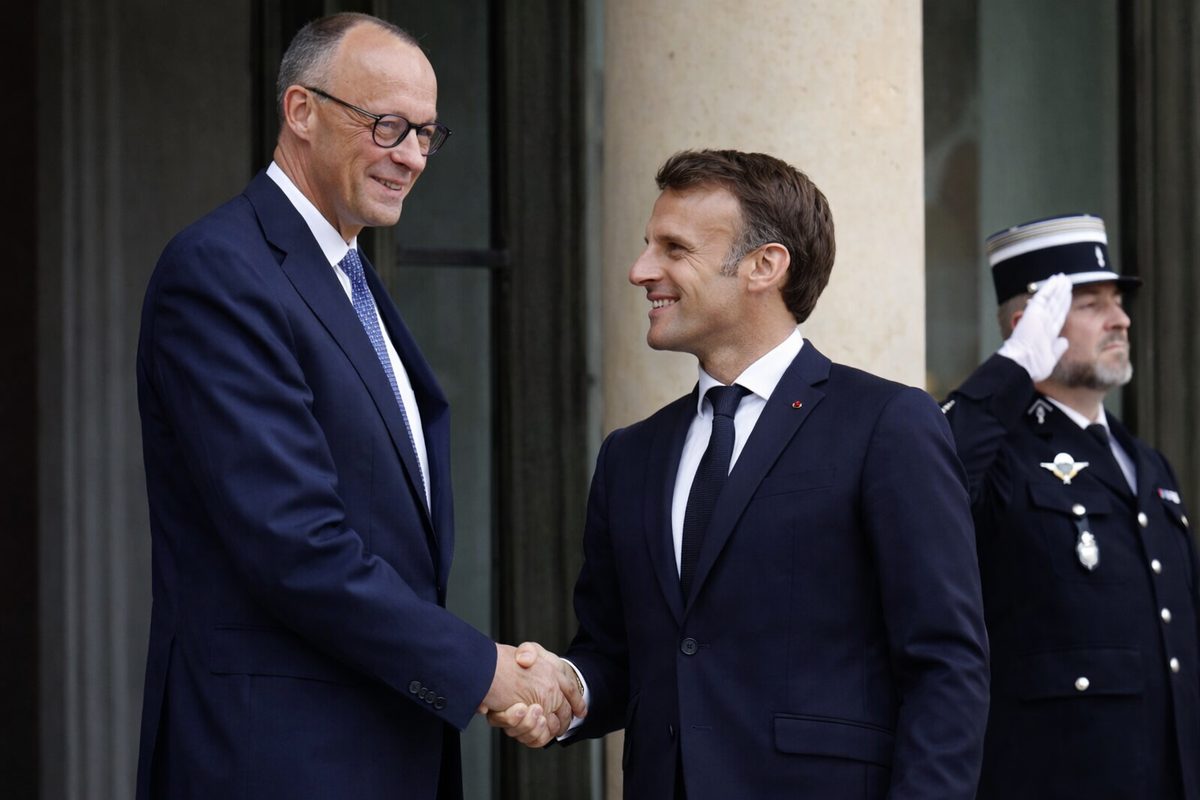
BRUSSELS/BERLIN — The leaders of the EU's two largest economies want Brussels to get a new trade weapon — and they want it fast. French President Emmanuel Macron and German Chancellor Friedrich Merz wrote to European Commission President Ursula von der Leyen on Monday, proposing a rapid-action trade defence instrument that could hit back at countries harming the bloc, with what they called "systemic market-distorting practices", Reuters reported.
The letter arrives ten days before EU leaders are due to discuss Chinese trade imbalances at a summit in Brussels, and its intended target is an open secret: China.
A 'kill switch' for market access
The Franco-German proposal, laid out in a joint letter and an accompanying paper seen by the South China Morning Post, would give the European Commission a "credible instrument" for a "decisive and systemic reaction" — with measures going as far as "an immediate cut-off from the internal market if needed".
The instrument would not name any country, but its catalogue of offences reads like a description of Chinese industrial policy: dumping, widespread state subsidies, and restrictions on currency convertibility. One of its headline features is "activation by reversed qualified majority" — meaning the Commission could deploy it unless a qualified majority of member states blocks it, a far lower political bar than the unanimity such escalation normally requires.
German officials framed it as Europe's answer to Washington's Section 301 tariffs and to Beijing's own coercive tools, such as last year's restrictions on critical-mineral exports that rippled through global supply chains and forced some Western plants to curtail production. According to the Wall Street Journal, one German official described the tool as a "second-strike weapon" — designed to be deployed only in response to coercive measures such as massive, sudden or arbitrary tariffs or export bans, and meant to work above all as a deterrent.
Why now: the 'China Shock 2.0'
The timing is no accident. EU trade chief Maroš Šefčovič is flying to Beijing on Thursday for two days of high-stakes talks aimed at staving off a full trade war, and policymakers on both sides increasingly warn of a "China Shock 2.0" — Chinese firms expanding into more advanced industries, echoing the wave of low-cost imports that hollowed out European manufacturing in the early 2000s. EU and Chinese officials have been negotiating since June over the bloc's growing trade imbalance, with Šefčovič demanding "tangible results by October".
What changed Berlin's mind is closer to home: flagship companies, including Volkswagen, have announced massive job cuts in recent months, souring Germany's traditionally China-friendly business lobby and paving the way for the Franco-German initiative. The proposal also flags urgent action on imports of chemicals, PET and hybrid vehicles — and calls for the Commission to deploy existing trade defence tools "more swiftly and efficiently", with more investigations and a broader, whole-sector approach.
Brussels welcomes the letter — but the road is long
The Commission said it welcomed the letter, calling it a valuable contribution to the debate on geo-economic risks and global imbalances, and said it aligned with von der Leyen's competitiveness agenda. The Franco-German paper also asks the Commission to propose two additional instruments to diversify supply chains and strengthen the bloc's economic security.
But analysts are cautious about what happens next. As Macau Business notes, the Commission is already working on new protective instruments, with proposals expected before EU leaders in December — yet Penny Naas of the German Marshall Fund predicted only "a few crumbs" from the Beijing talks, "not any kind of major breakthrough".
The Chinese Chamber of Commerce to the EU said it was concerned the new instrument, modelled on Section 301, could increase uncertainty and undermine mutual trust. And German officials concede the weapon could equally be pointed at the United States should the trade war ignited by President Trump last year flare up again.
Table of contents
- A 'kill switch' for market access
- Why now: the 'China Shock 2.0'
- Brussels welcomes the letter — but the road is long
- What this means for markets
What this means for markets
For investors and exporters, the proposal is a signal that the era of defensive, slow-moving EU trade policy is ending. Europe has long been seen as the world's most exposed major economy — open to trade, but without Washington's tariff muscle or Beijing's state machinery. A rapid-action instrument would mark a decisive shift toward a world where trade is openly used as a weapon.
For China, the letter is both a threat and an invitation: concessions in the Beijing talks this week could defuse the proposal before it becomes law. For everyone else doing business in Europe, the lesson is that supply-chain planning now has to price in not just tariffs, but the possibility of sudden exclusion from the world's second-largest consumer market.
This is part of a broader pattern of European economic hardening — from winter energy savings (our earlier coverage) to the increasingly tense trade dynamics in Asia, such as the Philippines' standoff with China (covered here).
Frequently Asked Questions
What are Macron and Merz proposing?
The French president and German chancellor have proposed that the EU create a new rapid-action trade defence instrument allowing the European Commission to respond decisively to "systemic market-distorting practices" — including measures up to an immediate cut-off from the EU internal market. It would be activated by reversed qualified majority, making deployment much easier than today's unanimity-based tools.
Does the proposal target China specifically?
Officially, no — the text does not name any country. But it lists dumping, widespread subsidies and currency-convertibility restrictions as the distortions it addresses, all of which EU leaders associate with China, and it was sent ten days before an EU summit dedicated to Chinese trade imbalances. The Wall Street Journal quotes German officials saying it could also be used against the US.
How is this different from existing EU trade tools?
Existing EU trade defence instruments — anti-dumping and anti-subsidy duties — are slow, case-by-case and require lengthy investigations. The new tool is designed to be fast, systemic and capable of covering whole sectors, modelled partly on America's Section 301 tariffs, which give Washington broad leeway to punish trade partners.
What happens next?
EU trade chief Maroš Šefčovič travels to Beijing on Thursday for two days of talks aimed at averting a trade war. The Commission is already preparing new protective instruments, with proposals expected before EU leaders in December. Analysts expect limited progress in Beijing, so the political momentum behind the Franco-German proposal is likely to grow.