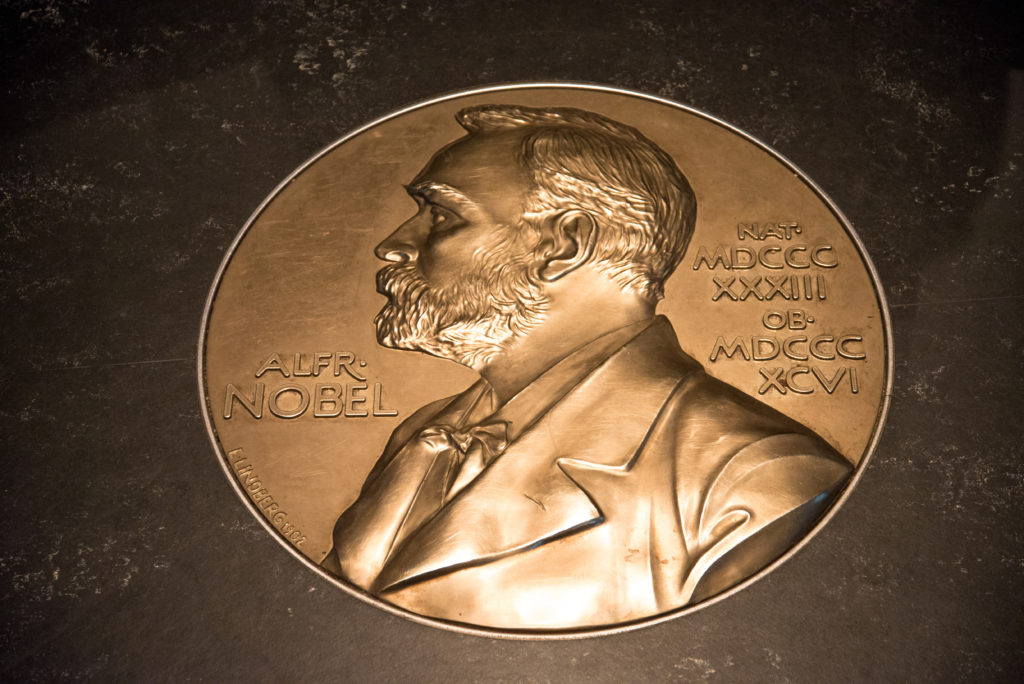
STOCKHOLM — American economists Robert E. Hall and Michael Woodford have won the 2026 Nobel Prize in economics for their work on "the microeconomic foundations of macroeconomic stabilisation," the Royal Swedish Academy of Sciences announced on Monday. The award closes this year's Nobel season, which began with the medicine prize last week and ended days after the peace prize went to South African jurist Navi Pillay.
The academy said the two laureates built new macroeconomic models that have substantially improved governments' ability to run effective stabilisation policy. Well-timed fiscal and monetary measures, grounded in those models, can soften the economy's booms and busts, Reuters reported from the Stockholm announcement. The prize, formally the Sveriges Riksbank Prize in Economic Sciences in Memory of Alfred Nobel, is worth 12 million Swedish crowns, roughly $1.2 million.
Hall, of Stanford University, and Woodford, the John Bates Clark Professor of Political Economy at Columbia University, have spent decades explaining how the decisions of individual households, firms and workers ripple up into economy-wide outcomes — inflation, unemployment and the effectiveness of policy itself.
Contents
- Who are the laureates?
- What the research explains
- Why stabilisation policy matters in 2026
- Nobel season 2026: the full list
- The economics prize's unusual status
- Frequently Asked Questions
- Sources
- Related Chronicle coverage
Who are the laureates?
Robert E. Hall is a professor of economics at Stanford University whose career has centred on one of economics' hardest questions: why do recessions happen, and why does unemployment sometimes stay high long after they begin? His research mapped how wages, hiring and spending by individual firms and households interact to produce the slumps and recoveries that policymakers struggle to manage.
Michael Woodford is the John Bates Clark Professor of Political Economy at Columbia University and one of the defining monetary theorists of his generation. His landmark 2003 work, Interest and Prices, rebuilt the theory of how central banks should set interest rates on foundations of household and firm behaviour — underpinning the interest-rate rules, inflation targets and forward-guidance strategies that central banks around the world now use routinely.
What the research explains
Macroeconomics once relied on relationships drawn from economy-wide aggregates: cut interest rates, growth rises; spend more, unemployment falls. Hall and Woodford's contribution was to rebuild those relationships from the bottom up — from how a household actually decides to save or spend, how a firm decides to hire or cut, and how those microeconomic choices aggregate.
The payoff is practical. Models with sound microeconomic foundations can tell a central bank or finance ministry not just whether an interest-rate cut or a stimulus package will work, but when and under what conditions — and why the same medicine can misfire if people's expectations and constraints have shifted. The academy summarised it plainly: on the basis of the laureates' models, well-timed fiscal and monetary measures can reduce the economy's peaks and troughs.
That idea now shapes everyday policy. When the world's central banks weighed the inflation surges of the mid-2020s, or when governments debated how aggressively to cushion households, they were operating — knowingly or not — in the intellectual framework Hall and Woodford helped construct.
Why stabilisation policy matters in 2026
The choice of citation feels deliberately timely. The global economy in 2026 is living through a stress test of stabilisation policy: tariff shocks rippling through supply chains, energy markets unsettled by conflicts in the Middle East and Ukraine, and central banks balancing inflation against fragile growth.
The academy's decision honours theory, but it also honours a kind of public infrastructure. As one analyst cited by The Hindu put it, the laureates' models are the tools governments reach for when they need to decide whether to intervene — and how hard.
It is also a prize for an American tradition: most economics laureates have been from the United States, though only three women have ever received the award, most recently Claudia Goldin in 2023 for her work on gender, pay and employment.
Nobel season 2026: the full list
With the economics announcement, the 2026 Nobel season comes to a close. The season's earlier awards:
- Medicine — announced first, for research in optogenetics and neuroscience.
- Physics — Belgian scientist Francis Halzen, for decisive contributions to the IceCube neutrino observatory and the discovery of high-energy cosmic neutrinos.
- Chemistry — Frenchman Henri Kagan and Japan's Kenso Soai, for work in asymmetric organic synthesis.
- Literature — Canadian writer Anne Carson, a win Chronicle covered in detail earlier this month.
- Peace — Navi Pillay, the South African jurist and former UN human rights chief, recognised on Friday for her work defending international law — an award that ended months of speculation driven by Donald Trump's public campaign for the prize.
The economics prize's unusual status
The economics award is formally the Bank of Sweden Prize in Economic Sciences in Memory of Alfred Nobel. Unlike the other five, it was not created in Nobel's 1895 will; Sweden's central bank established it in 1968 in his memory, and it was first awarded in 1969. Purists insist it is technically not a Nobel Prize — but it is announced, presented and celebrated together with the others each December in Stockholm.
Frequently Asked Questions
Who won the 2026 Nobel Prize in economics?
Robert E. Hall of Stanford University and Michael Woodford of Columbia University, jointly, "for microeconomic foundations of macroeconomic stabilisation."
What does their research say?
In essence: individual decisions by households and firms determine how well government policy works. Well-designed models built on those microeconomic foundations let policymakers time fiscal and monetary measures so they soften booms and recessions rather than miss the moment.
Why is it the last Nobel announced?
The economics prize is awarded last by tradition, a week after the medicine, physics, chemistry, literature and peace prizes. This year's announcement on Monday, October 12, closed the 2026 season.
How much is the prize worth?
Twelve million Swedish crowns, roughly $1.2 million, shared by the laureates.
Is the economics prize a "real" Nobel?
Formally it is the Sveriges Riksbank Prize in Economic Sciences in Memory of Alfred Nobel, created by Sweden's central bank in 1968 rather than in Nobel's will. It is nonetheless treated as a full member of the Nobel family in every public respect.
Sources
- Reuters — Hall and Woodford win announcement
- The Hindu — Academy statement and context
- South China Morning Post — laureate affiliations and announcement details
- Japan Times — prize history and background
- CNN — announcement summary