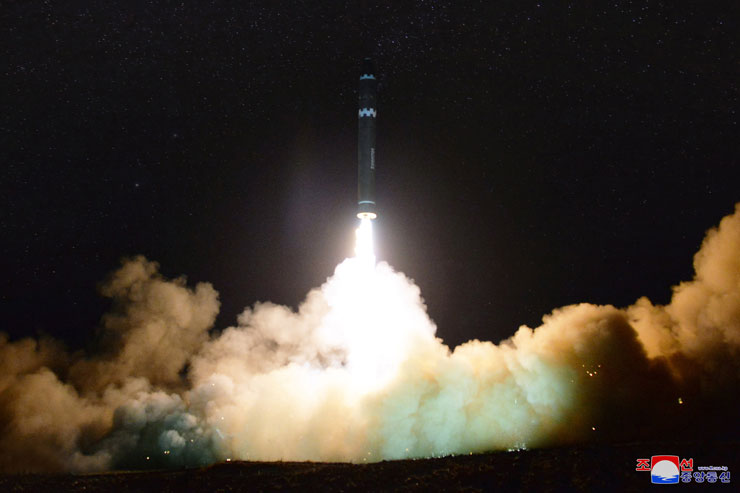
North Korea fired multiple ballistic missiles off its east coast on Monday, South Korea's military said, in a launch that further heightens tensions along one of the world's most heavily armed borders.
According to South Korea's Joint Chiefs of Staff, the missiles were launched from the Pyongyang area toward the Sea of Japan, with at least one flying more than 900 kilometres, as reported by Al Jazeera. Japan's government confirmed that at least one suspected ballistic missile had been detected. Seoul said it had stepped up surveillance and was coordinating closely with Washington and Tokyo.
France 24 reported that the launch comes amid a sharp deterioration in inter-Korean relations, following border landmine explosions that injured three South Korean soldiers last month.
A familiar pattern, at a sharper moment
North Korea's missile tests have become a grimly familiar feature of the peninsula's calendar, but this one lands at a moment when the usual guardrails look thinner. Inter-Korean relations are at their worst in decades, and the north has increasingly framed its launches as responses to allied military activity.
Seoul's announcement was deliberately clinical — time, launch point, approximate range — the standard language of a military that wants to demonstrate it is watching everything. The 900km-plus flight path puts much of the region within reach and will likely register in Tokyo, where the government has built its missile-alert drills around exactly this kind of launch.
The landmine blast that set the tone
The immediate backdrop is a landmine explosion at the DMZ that wounded three South Korean soldiers last month. North Korea has spent the year mining and reinforcing its side of the Demilitarized Zone, turning the world's most fortified border into an even more dangerous place.
In Pyongyang's telling, missile launches are the symmetrical answer to what it calls hostile acts by Seoul and Washington. South Korea's own first hypersonic gliding-vehicle test — successfully conducted this year — has given the north fresh material for that narrative, and defence analysts see the two programmes as locked in a tit-for-tat race neither side intends to lose.
What the trajectory tells analysts
The details Seoul has released so far are thin but telling: multiple missiles, launched from near the capital rather than a coastal site, with ranges consistent with medium-range ballistic missiles. That profile suggests both a demonstration of strike reach and a data-gathering exercise — each launch refines the programme's reliability, guidance and readiness.
For Washington, the test arrives as the Trump administration juggles crises across Asia, from the Strait of Hormuz to Taiwan. For Seoul, it is another test of deterrence messaging: firm enough to reassure a domestic public weary of provocations, restrained enough to avoid escalation.
What happens next
The immediate question is whether the north follows this launch with more tests, or whether this was a one-shot signal timed to register before diplomatic attention moves elsewhere. Past patterns suggest a burst of activity often comes in clusters, and the coming weeks will test whether the peninsula's already-strained deterrence architecture can absorb another round without a miscalculation.
Frequently Asked Questions
What did North Korea launch on October 12?
South Korea's Joint Chiefs of Staff said North Korea fired multiple ballistic missiles from the Pyongyang area toward the Sea of Japan. At least one flew more than 900 kilometres. Japan also confirmed a suspected ballistic missile.
Why does the timing matter?
The launch follows last month's landmine blast at the DMZ that injured three South Korean soldiers, and comes after Seoul's own successful hypersonic glide-vehicle test — both of which have sharpened the tit-for-tat dynamic on the peninsula.
How did South Korea and Japan respond?
Seoul said it increased surveillance and readiness, and was sharing tracking data with the United States and Japan. Tokyo confirmed the detection and reiterated its condemnation of the launches.
Do these launches break international rules?
Ballistic missile launches by North Korea are prohibited under United Nations Security Council resolutions. Pyongyang rejects those resolutions and has continued its programme despite sanctions.
What should analysts watch next?
Whether the north conducts follow-up launches in the coming days, any statement from Pyongyang framing the test, and how Seoul and Washington calibrate their response — exercises, sanctions pressure or renewed deterrence messaging.