North Korea has completed external work on a further extension to its original uranium enrichment facility at the Yongbyon nuclear complex, the head of the United Nations nuclear watchdog said on Wednesday, in the latest evidence that Pyongyang is steadily expanding its capacity to produce weapons-grade nuclear material. Rafael Grossi, Director General of the International Atomic Energy Agency (IAEA), told the agency's 35-nation Board of Governors in Vienna that construction on the extension began in mid-September and was "externally complete by late-October 2026".
Table of Contents
- What the IAEA announced
- Two expansions, not one: untangling the Yongbyon timeline
- Kangson: the second front of the expansion
- What the new capacity could mean in warhead terms
- What satellites can — and cannot — prove
- The diplomatic timing: Trump, Kim and Shenzhen
- Key takeaways
- Frequently Asked Questions
- Sources
- Chronicle further reading
What the IAEA announced
In his opening statement to the Board of Governors, Grossi said the agency continues to monitor North Korea's nuclear programme and that "the ongoing expansion of the DPRK's uranium enrichment programme remains a cause for serious concern". Reuters reported that Grossi described the newly completed extension as an addition to the original enrichment plant at Yongbyon, North Korea's main nuclear complex about 90 kilometres north of Pyongyang.
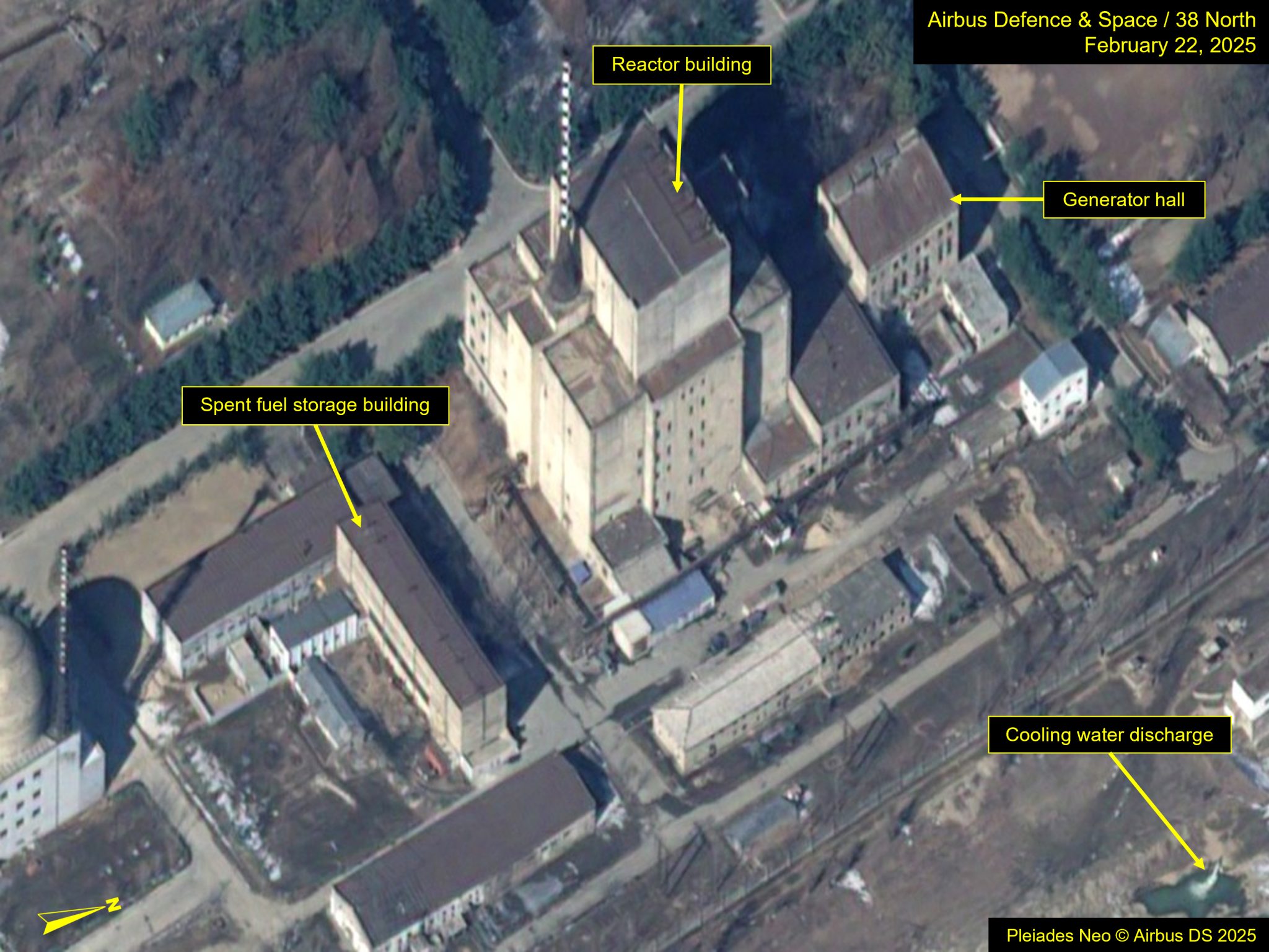
Grossi also reported indications that the 5MW(e) reactor at Yongbyon is likely continuing to operate, and that another reactor at the site — a light-water reactor — has been operating since April of this year. The agency's findings were presented at its quarterly Board meeting in Vienna on November 18.
Two expansions, not one: untangling the Yongbyon timeline
Much of the coverage of North Korea's enrichment programme risks confusing two separate construction projects at the same site. They are worth separating, because together they show how fast the programme is growing.
The first is a new two-storey enrichment hall at Yongbyon that the IAEA identified in a report in September. Construction on that building began in December 2024, and satellite analysts traced its rise for nearly two years before the agency formally linked it to uranium enrichment. The hall is large — roughly 120 by 48 metres — and the IAEA assesses it could accommodate as many as 28 centrifuge cascades. North Korean leader Kim Jong Un visited the facility in June, praising its expanded capacity in photographs later published by state media, which the IAEA cross-checked against satellite imagery to confirm that centrifuge cascades had been installed on both floors.
The second is the project Grossi announced on Wednesday: a further extension to the original Yongbyon enrichment facility, distinct from the new two-storey hall. Work on it began only in mid-September 2026 and was externally complete by late October — a pace of roughly six weeks from groundbreaking to an externally finished structure. That speed is itself significant: it suggests a construction programme that is no longer experimental but industrial in tempo, able to add enrichment capacity in weeks rather than years.
Kangson: the second front of the expansion
Yongbyon is not the only site growing. The IAEA has also detected expanded enrichment activity at Kangson, a suspected enrichment complex near Pyongyang. An annex built next to the existing Kangson facility in 2024 showed indications of having started operations in January 2026, and the agency said it could not rule out the possibility that highly enriched uranium is being produced in parts of the Kangson facility.
North Korea is believed to operate uranium enrichment facilities at Yongbyon, Kangson and Kusong. The fact that expansion is now visible at more than one location at the same time points to a coordinated programme to increase fissile-material output across the board, rather than a single showcase project.
What the new capacity could mean in warhead terms
The IAEA does not publish its own estimate of how much highly enriched uranium the new Yongbyon hall could produce. But independent analysis cited by 38 North, the US-based monitoring group, put the figure at roughly 100 to 200 kilograms of highly enriched uranium per year for the 28-cascade facility, under certain operating assumptions. For scale, a single nuclear weapon typically requires on the order of 15 to 25 kilograms of weapons-grade uranium, depending on design — so the upper end of that estimate would represent material for several additional weapons a year from this one building alone.
Those numbers carry wide uncertainty, and the IAEA itself stresses that it cannot verify how many centrifuges are installed, how efficiently they run, or how much material has actually been produced. But the direction of travel is unambiguous: every new hall and every new annex adds to a stockpile that, by the agency's own account, already violates multiple United Nations Security Council resolutions.
What satellites can — and cannot — prove
One of the most important gaps in most reporting on this story is the verification problem. The IAEA has had no inspectors inside North Korea since Pyongyang expelled them in April 2009. Everything the agency knows about Yongbyon and Kangson today comes from commercial satellite imagery, open-source material and photographs published by North Korean state media.
That monitoring is sophisticated — analysts can track construction, detect heat signatures, observe cooling-water discharge and match rooflines to state-media photographs — but it has hard limits. Satellites can show that a building exists and is externally complete. They cannot sample material, inspect centrifuges or confirm what enrichment level a facility is actually achieving. As one assessment put it, the IAEA's findings are evidence of capacity and layout, not a direct measurement of how much highly enriched uranium has already been produced. That distinction matters: the world knows North Korea's enrichment infrastructure is growing, but no outside body can say precisely how large its stockpile has become.
The diplomatic timing: Trump, Kim and Shenzhen
Grossi's announcement lands in a charged diplomatic moment. US President Donald Trump is travelling to China for a trilateral meeting with Chinese President Xi Jinping and Russian President Vladimir Putin in Shenzhen on November 19 — the first such three-way summit. On the same day, US Secretary of State Marco Rubio said Trump was open to meeting North Korean leader Kim Jong Un, while stressing that engaging with adversaries should not be viewed as a concession. No talks have been confirmed.
The timing is unlikely to be coincidental in its effect, whatever Pyongyang's intent. North Korea's nuclear programme has historically advanced fastest when diplomacy stalls, and each new IAEA finding raises the price of any future negotiation: the more enrichment capacity exists, the more there is to freeze, cap or dismantle. Whether the Shenzhen summit or a possible Trump–Kim meeting changes that trajectory remains an open question — but the Yongbyon extension means any future talks would start from a larger North Korean arsenal than the last round did.
Key takeaways
- A further extension to the original Yongbyon uranium enrichment facility was built between mid-September and late October 2026, the IAEA said on November 18.
- It is separate from a new two-storey hall at Yongbyon, identified in September, that could hold up to 28 centrifuge cascades.
- Enrichment activity is also expanding at Kangson, near Pyongyang, where an annex built in 2024 began operating in January 2026.
- The IAEA has had no inspectors in North Korea since 2009 and relies on satellite imagery and open sources, so exact output cannot be verified.
- The announcement comes as Trump heads to Shenzhen for a trilateral summit with Xi and Putin, and as Rubio says Trump is open to meeting Kim Jong Un.
Frequently Asked Questions
What exactly did the IAEA announce about Yongbyon on November 18?
Director General Rafael Grossi told the IAEA Board of Governors that a further extension to the original uranium enrichment facility at Yongbyon had been under construction since mid-September 2026 and was externally complete by late October 2026. He said the ongoing expansion of North Korea's uranium enrichment programme "remains a cause for serious concern".
Is this the same as the new enrichment hall reported in September?
No. The September IAEA report identified a new two-storey enrichment facility at Yongbyon, construction of which began in December 2024, that could accommodate up to 28 centrifuge cascades. The November announcement concerns a further extension to the original, older enrichment plant at the same complex — a separate and more recent construction project.
How much weapons-grade uranium could the new facilities produce?
The IAEA does not publish its own output estimate. An expert estimate cited by 38 North suggested the 28-cascade hall might be capable of producing roughly 100 to 200 kilograms of highly enriched uranium per year under certain operating assumptions. A single nuclear weapon typically requires on the order of 15 to 25 kilograms, so the upper end of that range would represent material for several additional weapons a year.
Why can't the IAEA verify North Korea's nuclear programme directly?
North Korea expelled IAEA inspectors in April 2009, and the agency has had no access to the country since. It monitors the programme using commercial satellite imagery, open-source information and photographs published by North Korean state media. Satellites can confirm construction and layout, but cannot sample material or inspect equipment.
Does the expansion violate international law?
The IAEA says the continued operation and expansion of North Korea's enrichment facilities violate relevant United Nations Security Council resolutions, which prohibit Pyongyang from developing nuclear weapons and ballistic missile programmes.
Sources
- Reuters — "IAEA says North Korea is expanding uranium-enrichment plant at Yongbyon", November 18, 2026.
- IAEA — Director General's Introductory Statement to the Board of Governors, November 18, 2026.
- The Korea Times — "N. Korea external works on enrichment facility extension complete: IAEA", November 18, 2026.