Romania's president has directly accused Russia of escalating its campaign against NATO's eastern flank after a drone strike sank a cargo ship off Romania's Black Sea coast on Friday, killing one sailor and leaving three more missing. The attack on the Comoros-flagged vessel Khoryv caps a two-week surge of violence against commercial shipping in which at least seven cargo ships have been hit and some 30 sailors killed or gone missing — a toll that has turned one of the world's vital grain and energy corridors into a war zone.
"It is part of Russia's escalation process in its war in Ukraine," President Nicusor Dan told reporters on Friday, adding that the ship had been hit by a drone, according to Reuters.
Table of Contents
- A distress signal off Constanta
- Dan's accusation: an escalation against NATO's flank
- Two weeks of fire: seven ships, dozens of casualties
- NATO moves ships and aircraft into the Black Sea
- Why the Sulina corridor is the prize
- Key takeaways
- Frequently Asked Questions
A distress signal off Constanta
The incident unfolded around 10 a.m. local time on Friday, when the Khoryv's crew sent a distress signal from about 13 nautical miles off the Romanian port of Constanta — just beyond Romania's territorial waters. The vessel, an oil cargo carrier sailing under the flag of Comoros, had departed Turkey on October 21 and was bound for Romania's Sulina port, shipping data tracked by MarineTraffic shows.
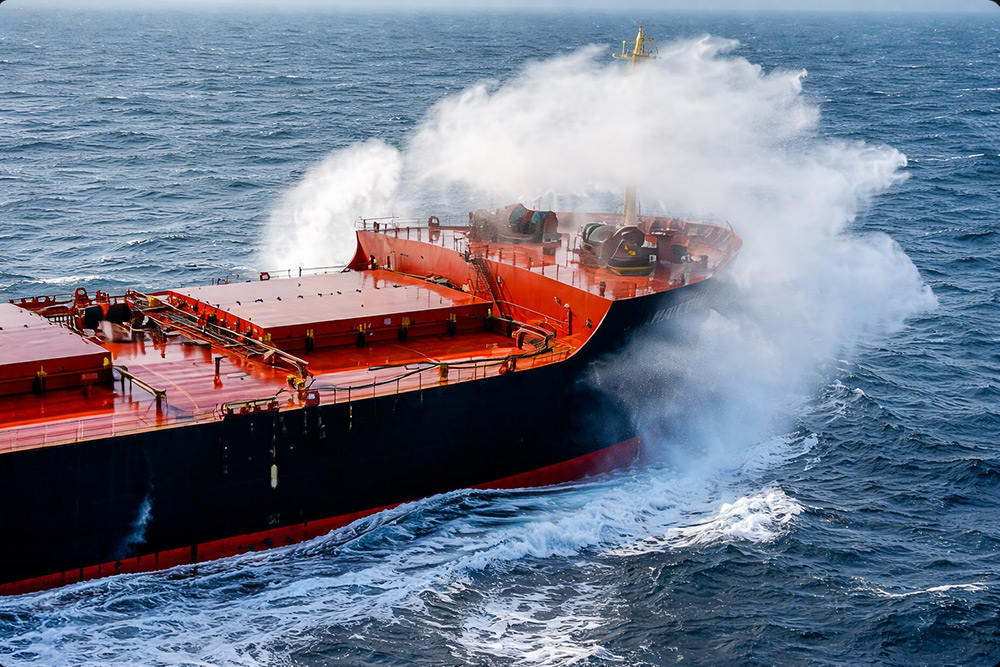
Romania's naval authority reported that the ship suffered major damage, caught fire and capsized, facing an imminent risk of sinking. Video released by Romanian authorities showed only a small section of the capsized hull still visible above the waves. The 13-member crew — ten Ukrainian citizens and three Azerbaijanis — faced a chaotic evacuation into rough seas. A passing commercial vessel recovered ten sailors from the water, nine alive and one deceased; three crew members remain missing as emergency vessels continue the search in choppy seas and high wind. Low visibility and bad weather made it impossible to deploy a helicopter, the naval authority said, as reported by Times Now.
While the president publicly identified a drone strike as the cause, Romanian authorities have not yet formally confirmed the origin of the fire — an investigative gap that has not stopped Bucharest from reading the attack as part of a deliberate campaign.
Dan's accusation: an escalation against NATO's flank
Dan's language was unusually blunt for a leader whose country has often responded to cross-border incidents with careful ambiguity. By naming Russia and describing the attack as an "escalation" against NATO's eastern flank, he placed the sinking inside the framework of a widening confrontation rather than treating it as collateral spillover from the war in Ukraine.
The framing matters. Friday's sinking came just six days after Romanian F-16s shot down two drones minutes after they entered national airspace near Sulina — an interception Defence Minister Radu Miruta presented as proof that Romania's air defences are working. Together, the two incidents suggest Bucharest is abandoning its old posture of quiet monitoring in favour of direct confrontation and public attribution.
Two weeks of fire: seven ships, dozens of casualties
The Khoryv is not an isolated case. The past two weeks have seen a sudden and deadly surge in attacks on commercial ships off the coasts of NATO members Romania and Bulgaria, with at least seven cargo vessels hit and some 30 sailors reported dead or missing, according to Reuters reporting carried by Al Jazeera.
The pattern is strikingly consistent: the vessels struck have either been anchored near or heading towards the Sulina Canal — the waterway that links the Danube River to the Black Sea. Chronicle has tracked the campaign as it unfolded, including drone strikes that set two tankers ablaze off Romania's coast earlier this month, a Russian drone strike on a Liberian-flagged tanker with an Indian crew, and a ship that sank in Bulgarian waters during the same wave of attacks.
No party has claimed responsibility for the attacks, and Moscow has not responded publicly to Dan's accusation. But the concentration of strikes along a single shipping lane — and their acceleration over the last fortnight — is hard to read as coincidence.
NATO moves ships and aircraft into the Black Sea
The alliance is already responding. On Tuesday, NATO said it would send more maritime patrol aircraft, radar systems and drones to the Black Sea, though it has not specified what capabilities are being deployed. Romania has also begun intercepting intruding drones directly: on Saturday, Romanian jets shot down two of the latest generation of Russian drones over Romanian territorial waters, just days after the F-16 interceptions of October 17.
Romania's foreign minister has previously said the Black Sea drone campaign will be raised at the North Atlantic Council, describing the sea as a critical maritime artery for the global export of grain, energy and industrial commodities. The question now is whether NATO's reinforcement will deter further attacks — or whether the campaign is designed precisely to test how far the alliance will go to protect commercial traffic in contested waters.
Why the Sulina corridor is the prize
The geography explains the violence. Since Russia began targeting Ukraine's own Black Sea ports, the Danube River ports and the Sulina Canal have become Ukraine's primary export route to world markets — one of the world's biggest channels for grain and food oils, plus energy and industrial goods. Attacking vessels on that corridor does double damage: it raises insurance premiums and frightens away shippers, and it squeezes Ukraine's most important remaining economic lifeline.
Every vessel anchored near Sulina is, in effect, sitting on the fault line between a commercial waterway and a war zone. Friday's sinking shows that the line is no longer holding.
Key takeaways
- A drone strike sank the Comoros-flagged cargo vessel Khoryv off Romania's Black Sea coast on October 23, killing one sailor and leaving three missing.
- Romanian President Nicusor Dan accused Russia of escalating its attacks on NATO's eastern flank, calling the strike part of Moscow's "escalation process."
- At least seven cargo ships have been hit in the past two weeks off Romania and Bulgaria, with some 30 sailors dead or missing.
- NATO announced on Tuesday it would send more patrol aircraft, radar and drones to the Black Sea; Romanian jets shot down two drones over the weekend.
- The attacks cluster around the Sulina Canal, Ukraine's main remaining export route for grain and energy.
Frequently Asked Questions
What happened to the Khoryv?
The Comoros-flagged cargo vessel Khoryv sent a distress signal about 13 nautical miles off Romania's port of Constanta on the morning of October 23, 2026. The ship caught fire, capsized and sank. Of the 13 crew members — ten Ukrainians and three Azerbaijanis — nine were rescued alive, one body was recovered, and three remain missing.
Who does Romania blame?
President Nicusor Dan said the ship was hit by a drone and accused Russia of escalating its attacks on NATO's eastern flank, describing it as part of "Russia's escalation process in its war in Ukraine." Moscow has not publicly responded, and Romanian authorities have not yet formally confirmed the cause of the fire.
How bad is the broader campaign against shipping?
According to Reuters reporting, at least seven cargo ships have been hit in the past two weeks off the coasts of NATO members Romania and Bulgaria, with some 30 sailors reported dead or missing. The vessels were typically anchored near or heading for the Sulina Canal.
What is NATO doing?
NATO said on Tuesday it would send more maritime patrol aircraft, radar systems and drones to the Black Sea. Romania has also stepped up interceptions: its F-16s shot down two drones over Romanian territorial waters last weekend, days after an earlier double interception on October 17.
Why is the Sulina Canal so important?
The canal links the Danube River to the Black Sea and has become Ukraine's primary export route for grain, food oils, energy and industrial goods since Russia began attacking Ukraine's own Black Sea ports. Disruptions there threaten global food and energy security.