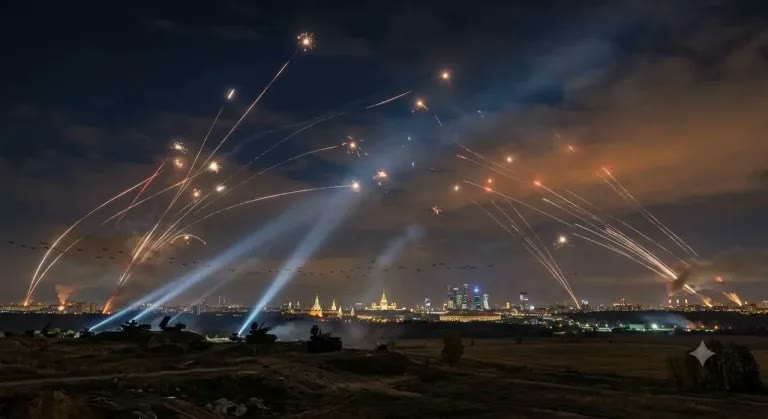
Ukraine launched one of the largest aerial attacks of the war overnight, sending around 600 drones toward Moscow and striking the bridge linking Russia to occupied Crimea, as Russia claimed a record 1,336 interceptions across the country (France 24).
Moscow's mayor, Sergei Sobyanin, said about 600 drones had been heading for the capital and its surrounding region between 4pm on Sunday and 7am on Monday, Kyiv time, and that Russian air defences had destroyed 191 of them on their approach to the city (Censor.NET). Russia's Defence Ministry put the nationwide overnight total far higher, saying its forces intercepted and destroyed 1,336 Ukrainian drones across multiple regions, as well as over the Black Sea and the Sea of Azov (Türkiye Today).
The scale of the interceptions could not be independently verified, and no information was immediately released about casualties or material damage in the Russian capital. But the figures, even discounted, point to the biggest drone assault on Moscow since the start of the year — and one of the largest of the entire war.
The bridge strike
The overnight barrage also hit the Kerch Bridge, the road and rail link between Russia and occupied Crimea, halting traffic across the crossing (France 24). The bridge has been a recurring target for Kyiv since the full-scale invasion began: it is both a symbol of Moscow's annexation of the peninsula and a vital supply artery for Russian forces in southern Ukraine.
Traffic on the crossing was suspended while the attack was under way. Russian authorities did not immediately say whether the bridge itself had been damaged, or how long the closure would last.
The strike on the bridge came hours after Ukrainian forces hit a major Russian petrochemical plant, an oil refinery and a military production facility, in the latest phase of a campaign aimed at industrial and military infrastructure deep inside Russia.
Russia's reply: four killed in Odesa
Russia answered with its own overnight barrage. Strikes on Ukraine's southern Odesa region killed four people and injured 69, according to Ukrainian officials (Shafaq News).
Ukraine's General Staff said its own forces had struck a military airfield in Russia's Astrakhan region and a facility in the Oryol region used to store, prepare and launch drones. Russia's Defence Ministry, meanwhile, reported an attack on a cargo ship in the Black Sea, alleging the vessel was carrying military supplies to the Ukrainian port of Chornomorsk.
The exchange fits a pattern that has defined the war's recent months: each night brings hundreds of drones in both directions, with energy plants, refineries, airfields and ports on both sides under fire.
A war fought in the air, days before a summit
The timing is pointed. The barrage came just days before President Vladimir Putin is due to meet his American and Chinese counterparts in China — a diplomatic moment Kyiv has repeatedly used to demonstrate that it can still impose costs on Russia (Le Temps).
It also follows, by only a few days, an even larger Ukrainian operation: the nearly 1,200-drone attack of 12–13 November, in which Moscow claimed to have shot down 1,198 drones. Taken together, the two nights suggest Kyiv's long-range drone fleet is now capable of sustaining barrages on a scale that would have been unthinkable a year ago — hundreds of aircraft a night, night after night.
For Moscow, the numbers present a different problem. Even if the interception claims are taken at face value, the sheer volume of drones forces Russia to expend expensive air-defence missiles against cheap, mass-produced aircraft, while the drones that do get through keep hitting refineries, warehouses and military sites. A strike on a cargo ship in the Black Sea earlier in the campaign showed the same logic at sea: disrupt the logistics, and the front line feels it weeks later.
The diplomacy, meanwhile, continues in parallel. American-led efforts to negotiate an end to the war have widened to cover European security as a whole, a development that has alarmed European leaders — and that Kyiv's spectacular strikes are clearly intended to influence. As with the US proposal to trade Donbas territory for NATO membership, the message from Ukraine is consistent: any settlement will have to reckon with a country that can still fight, and still reach Moscow.
Frequently Asked Questions
How many drones did Ukraine send toward Moscow?
Moscow's mayor, Sergei Sobyanin, said around 600 drones were heading for the Moscow region between 4pm on 15 November and 7am on 16 November, Kyiv time, and that 191 were destroyed on their approach to the capital. Russia's Defence Ministry claimed 1,336 Ukrainian drones were intercepted nationwide overnight, a figure that has not been independently verified.
Was the Crimea bridge hit?
Yes — the Kerch Bridge linking Russia to occupied Crimea was struck during the overnight attack, and traffic across the crossing was halted, according to France 24's live coverage. Russian authorities did not immediately confirm the extent of any damage.
What did Russia do in reply?
Russian strikes on Ukraine's Odesa region killed four people and injured 69 overnight, Ukrainian officials said. Russia also reported an attack on a cargo ship in the Black Sea, which it alleged was carrying military supplies to the Ukrainian port of Chornomorsk.
Why is the timing significant?
The barrage came days before President Vladimir Putin is due to meet his American and Chinese counterparts in China. Kyiv has repeatedly timed large long-range strikes to coincide with diplomatic moments, to show it can still impose costs on Russia while talks about ending the war continue.