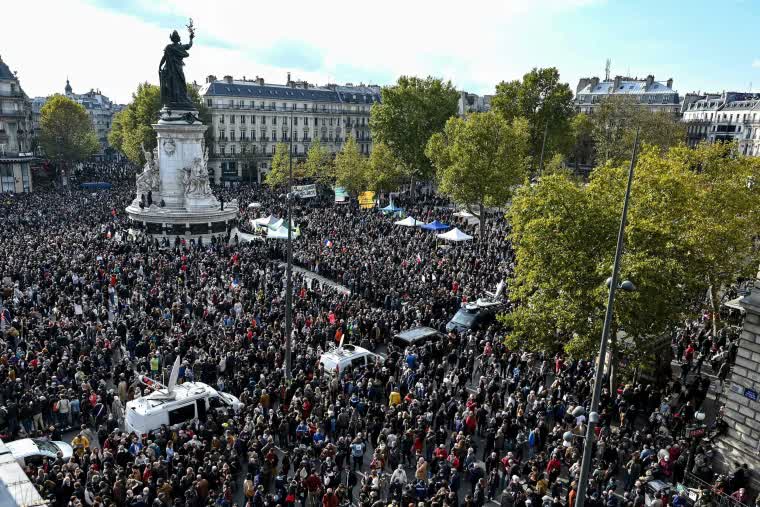
France braced on Saturday for a fifth consecutive weekend of nationwide protests, as a movement that began in September with schoolchildren complaining about staff shortages has hardened into the broadest anti-government mobilisation of Emmanuel Macron's presidency — fuelled now by a controversial bill expanding legal protections for police officers who use their weapons.
The main rally in Paris was scheduled for 1 p.m. local time, with dozens of other gatherings planned across the country, bringing together the Yellow Vest movement, high school and university students, trade unions and campaigners against the proposed police legislation. The bill, which would establish a presumption of legitimate self-defence for officers who fire their weapons, has passed the lower house of parliament and is awaiting consideration by the Senate.
From school gates to the streets
What makes this wave of unrest different from the protest cycles France has seen before is how quickly it spread — and how many different grievances it has absorbed along the way. According to a Reuters investigation published on Saturday, the movement began in September with small protests over conditions in state schools, sparked by a high school south-east of Paris protesting a shortage of staff. Within weeks it had drawn in labour unions, workers, farmers, retirees and students, all carrying their own complaints about wages, the cost of living and strained public services.
The turning point came on October 17. More than half a million people demonstrated across the country that day, including 110,000 in Paris, according to the interior ministry — and the day ended in some of the worst rioting France has seen in years. The violence was so intense that police lost control of entire neighbourhoods to rioters and looters in the country's three largest cities: Paris, Marseille and Lyon. That same day brought the resurgence of the Yellow Vest movement, the anti-establishment force that confronted Macron's government over fuel prices in 2018 and 2019.
Nearly 4,900 detained — and the crackdown itself becomes a grievance
The scale of the state's response has itself become one of the movement's central complaints. Justice Minister Gérald Darmanin told French television on November 3 that more than 4,900 suspects had been taken into custody since October 17, and he has instructed prosecutors to deliver what he called "an extremely firm judicial response" to the violence, including pre-trial detention and fast-track trials for many of the accused.
At the same time, the interior ministry said its internal watchdogs have launched 161 investigations into allegations of officer violence against protesters since September. Government officials have repeatedly blamed far-left radicals and "opportunistic delinquents" for the violence, saying they took advantage of mostly peaceful demonstrations to attack symbols of state authority and capitalism. But the heavy-handed response — thousands of arrests, police beatings and curbs on marches — has added to the volatile mix of grievances fuelling an anti-government groundswell that, Reuters found, shows no sign of abating before next year's presidential election.
The unrest has also drawn in new actors. On October 24, far-right gangs entered the fray, saying they wanted to protect businesses, and clashed with protesters in several cities, according to the authorities.
The numbers keep climbing
The movement's staying power is visible in the turnout figures, even as they fall from their peaks. On Thursday, November 5, more than 600,000 people marched across France, according to the interior ministry, demanding higher wages, better pensions and more money for schools. About a third of the country's high schools were closed or unable to operate that day, and 70,000 police officers were deployed.
Two days later, on Saturday, November 7, the interior ministry counted 146,000 demonstrators nationwide, including 46,000 in Paris, while unions put the figures at 250,000 and 75,000 respectively. Clashes erupted in Paris that day after a group of around 200 violent individuals attacked officers who were arresting a man who had set fire to a rubbish bin in the square, police said. The Yellow Vests had called a rival demonstration at the Place de la Concorde, a short walk from the Élysée Palace.
Trade unions have now called another strike for Tuesday, after rejecting the government's proposed 0.6% increase in the minimum wage as inadequate — a sign that the dispute is moving from the streets into the workplace.
A presidential campaign fought on the streets
The unrest is unfolding against a political clock. France votes for a new president next April, and Macron cannot stand for a third consecutive term. The constitution bars it. Marine Le Pen, the far-right candidate, is the favourite to win, according to the Associated Press — and the protests have become part of the campaign itself, with candidates on both the left and the right seeking to claim the anger on the streets.
Jean-Luc Mélenchon, leader of the far-left La France Insoumise and a candidate for the 2027 election, has marched with the protesters and accused the authorities of using force to shape how the demonstrations are perceived. The government, for its part, insists it is defending the right to demonstrate peacefully against a violent minority, while also saying it is listening: Prime Minister Sébastien Lecornu has met student unions several times and is due to meet unions and employer representatives on Monday to discuss wages and purchasing power.
Whether that is enough remains an open question. The movement has now survived five consecutive Saturdays, two nationwide strike days and a crackdown that has put nearly 5,000 people in custody — and still shows no sign of fading. For a government already weakened by months of political instability, the streets have become the arena where the race to replace Macron is being fought months before the first ballot is cast.
Related coverage: the October arrests are covered in 1,314 Arrested as 410,000 March Across France, and the earlier October marches in France: Nationwide Protests on October 17.
Frequently Asked Questions
How many people have been detained since the French protests escalated on October 17?
More than 4,900 suspects have been taken into custody since October 17, according to Justice Minister Gérald Darmanin, who told French television on November 3 that prosecutors had been instructed to pursue an "extremely firm judicial response", including pre-trial detention and fast-track trials.
What is the controversial police bill driving the latest protests?
The proposed legislation would establish a presumption of legitimate self-defence for police officers who use their weapons. It has passed the lower house of parliament and is awaiting consideration by the Senate. Protesters and their supporters say it would shield officers from accountability; the government argues it clarifies the rules for officers facing threats.
How did the protests in France begin?
The movement began in September 2026 with small protests over conditions in state schools, sparked by a high school south-east of Paris protesting a shortage of staff. It then spread to include trade unions, students, workers, farmers and retirees, with grievances over the cost of living, wages, fuel prices and public services, before the Yellow Vest movement returned to the streets on October 17.
When is France's next presidential election?
France votes for a new president in April 2027. President Emmanuel Macron cannot stand for a third consecutive term, as the constitution bars it. Marine Le Pen, the far-right candidate, is currently the favourite to win, according to the Associated Press.