Google has unveiled Gemini 4 Hydrogen, a new fast and low-cost artificial intelligence model, and opened pre-orders for its first Gemini-powered smart glasses, pairing a major upgrade to its AI line-up with its long-awaited return to consumer eyewear. Google
The two announcements landed on the same day, November 12, and together they show how Google plans to put its AI in front of users: a cheaper, quicker model doing the everyday work inside Search and the Gemini app, and a wearable device that brings the same assistant into the wearer's field of view.
A faster model built for everyday work
Gemini 4 Hydrogen is designed as the workhorse of the Gemini 4 family. Google says it completes tasks 2.5 times faster than Gemini 3.8 Flash, the model it replaces as the default for high-volume work, and that it scores 51 on the Artificial Analysis Intelligence Index at its default high reasoning level — one point ahead of Gemini 4 Argon, the larger model in the series, and 54 at its highest thinking setting. Google
The model supports a 1 million-token context window and multimodal inputs, including text, audio, images and video, with four thinking levels that let developers trade reasoning depth for speed. It is priced flat across that context window at $1.50 per million input tokens and $7.50 per million output tokens — less than half the price of Argon, according to reports on the launch.
Hydrogen is rolling out globally from November 12 across Google's developer, enterprise and consumer surfaces: Google Search for all users, the Gemini app, Google AI Studio, the Gemini API, Gemini for business, and Google Antigravity for paying AI Pro and Ultra subscribers. Google described the Search switch as the service's biggest model update, saying the new model should handle complicated questions and typos better than its predecessor.
The timing matters for Google's broader AI strategy. The company has been racing to make its flagship models cheaper to run at scale, since the cost of answering billions of everyday queries is what determines whether AI features can stay free for consumers. A model that is both faster and cheaper than the one it replaces lets Google upgrade Search without raising the bill — and gives developers a lower-cost option for agent-style applications that fire hundreds of small requests per task.
Smart glasses return, with Gemini inside
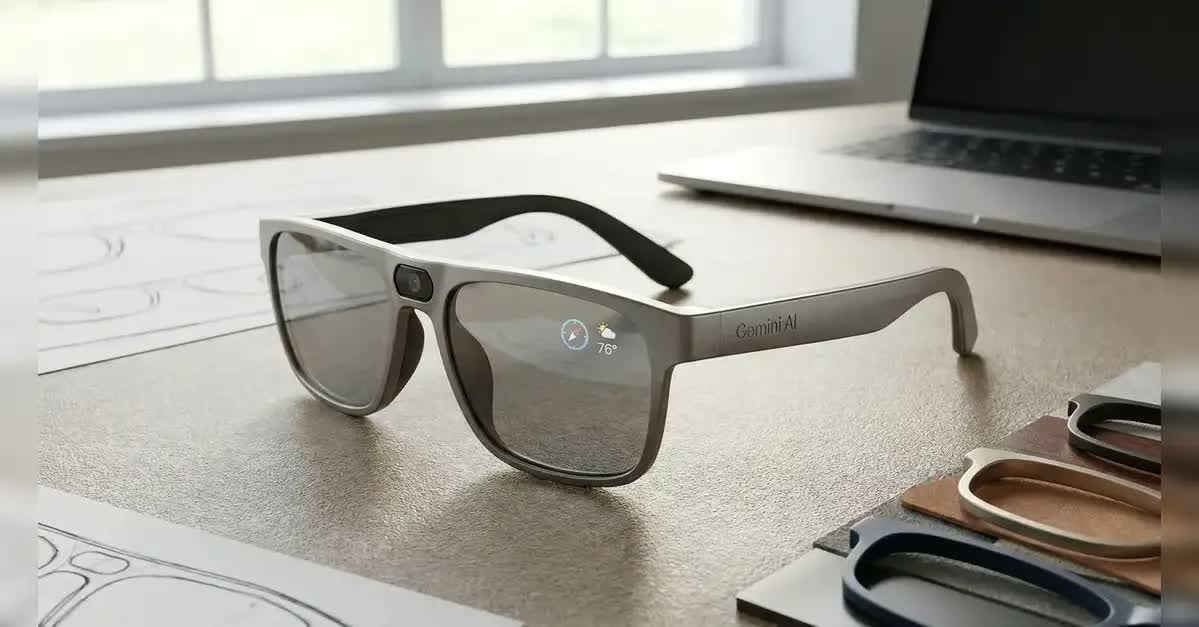
Alongside the model, Google opened pre-orders for its first Intelligent Eyewear: smart glasses powered by Gemini, developed with Samsung and two eyewear brands, Warby Parker and Gentle Monster. The glasses go on sale on December 10 in the United States and South Korea. LazyFounder
Warby Parker frames start at $395 across three styles, while Gentle Monster frames start at $449 across six designs, both before prescription lens upgrades. The hardware is a single specification across both brands: each pair weighs about 41 grams, runs roughly nine hours on a charge, and carries a 12-megapixel ultra-wide camera with HDR and image stabilisation, plus open-ear speakers and a charging case that refills the frames up to seven times.
The glasses run on Android XR, Google's mixed-reality platform, and use Gemini for hands-free tasks such as live translation, note-taking, computer vision, walking directions and photo capture. Google has also built in privacy measures, including tamper-proof LED indicators designed to show when the camera is recording.
It is Google's first smart glasses product since Google Glass was withdrawn in 2015, and it arrives in a market that has changed considerably since then. Meta's Ray-Ban glasses have sold around 7 million pairs, proving that consumers will wear AI glasses if they look like ordinary eyewear — a lesson Google has clearly taken on board by partnering with established fashion brands rather than designing the frames itself.
Why this launch matters
The two products are aimed at different parts of the same bet: that AI assistants will move from the phone screen into everything around us. Hydrogen makes that bet affordable to run, while the glasses make it wearable.
For Google, the stakes are also competitive. The launch comes in the same week that the wider AI industry is under intense scrutiny — from leadership turmoil at Nvidia to the rapid pace of model releases from rivals — and it gives Google a concrete product story at a moment when much of the news in tech has been about corporate drama rather than new technology.
There are open questions, too. The glasses are launching only in the United States and South Korea, with no date given for other markets, and a display version with a transparent lens is still in development. The first audio-and-camera version will have to prove that people want an AI assistant on their face badly enough to pay $395 for it — and that Google has solved the privacy concerns that helped sink Glass a decade ago.
For now, though, the message from Google is clear: its fastest cheap model is already in Search, and its smart glasses are ready to order.
Frequently Asked Questions
What is Gemini 4 Hydrogen?
Gemini 4 Hydrogen is Google's new fast, low-cost AI model, launched on November 12, 2026. It replaces Gemini 3.8 Flash as the default model for high-volume work, runs 2.5 times faster, and is available in Google Search, the Gemini app, Google AI Studio and the Gemini API.
How much does Gemini 4 Hydrogen cost?
Google prices Gemini 4 Hydrogen at $1.50 per million input tokens and $7.50 per million output tokens across its entire 1 million-token context window. It is free for users of the Gemini app and Google Search.
How much do Google's Gemini smart glasses cost?
Pre-orders start at $395 for Warby Parker frames and $449 for Gentle Monster frames, before prescription lens upgrades. The glasses ship on December 10, 2026, in the United States and South Korea.
What can the Gemini smart glasses do?
The glasses run on Android XR and use Gemini for hands-free tasks including live translation, note-taking, computer vision, walking directions, photo capture and calls. They have a 12-megapixel camera, open-ear speakers and about nine hours of battery life.
When do Google's smart glasses go on sale?
Pre-orders opened on November 12, 2026, and sales begin on December 10, 2026, in the United States and South Korea, through Warby Parker, Gentle Monster and the Google Store.
Further reading
Google's hardware ambitions have grown steadily in recent years, from wearables such as the Fitbit Edge launch to its expanding cloud infrastructure, which was tested by a major outage affecting UK banks last month. Its data-centre expansion has also faced pushback in Europe, where Finland halted work on a Google data centre earlier this year.