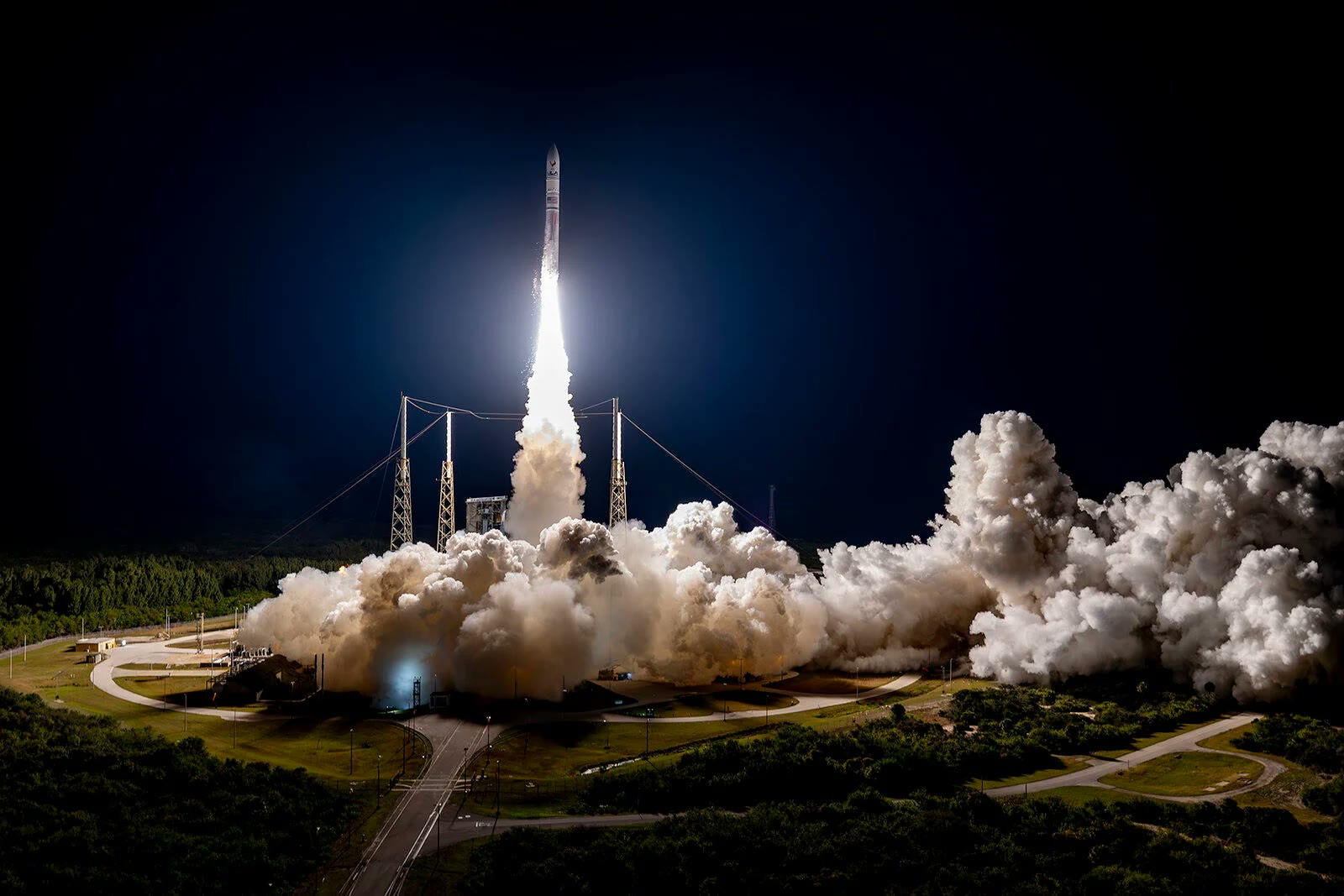
A United Launch Alliance Vulcan Centaur rocket failed about ten minutes into its flight from Florida on Sunday, 15 November, destroying all 40 Amazon Leo broadband satellites it was carrying. It is the first outright mission failure in the 20-year history of ULA, the Boeing–Lockheed Martin joint venture — and a heavy blow to Amazon's effort to build a satellite internet network capable of rivalling SpaceX's Starlink.
Table of Contents
- What happened on Sunday
- A return to flight that ended in failure
- Twenty years without a lost mission
- What the loss means for Amazon Leo
- The investigation ahead
- Key takeaways
- Frequently Asked Questions
- Sources
- Chronicle further reading
What happened on Sunday
The 214-foot Vulcan Centaur lifted off from Space Launch Complex 41 at Cape Canaveral Space Force Station at 12:40 p.m. Eastern Time, climbing on 3.8 million pounds of thrust from six strap-on solid rocket boosters and two methane-burning BE-4 engines built by Blue Origin. The six boosters separated cleanly about a minute and 45 seconds into the climb.
The trouble came later. According to The Financial Express, the anomaly struck after the first stage separated, during the first burn of the hydrogen-fuelled Centaur V upper stage — the stage carrying the satellites. Observers following the launch broadcast noted that the first stage appeared to burn longer than ULA's pre-launch timeline called for, and that the Centaur made unusual orientation adjustments early in its burn.
About 50 minutes after liftoff, ULA confirmed the loss in a statement: "Based on data received by our Launch Director, we confirm that the Vulcan vehicle launched from Space Launch Complex 41 suffered an anomaly 10 minutes into the flight and failed to deliver the Amazon mission to orbit."
The mission, designated LV-01 — also called Leo Vulcan 1 — was the fifth flight overall for Vulcan since the heavy-lift launcher debuted in January 2024, and the first Vulcan flight for Amazon's constellation. It was also the largest single batch of Amazon satellites ever launched at once: the 40 spacecraft were due to separate in 21 events into a 450-kilometre parking orbit. None of them reached orbit.
A return to flight that ended in failure
Sunday's launch was already a comeback story before it failed. Vulcan had been grounded since 12 February 2026, when a solid rocket booster nozzle failed during the USSF-87 national security mission — a nine-month stand-down for ULA's flagship rocket.
Even getting to the pad took three attempts. The launch was called off on 13 November because of a power outage at an external gaseous nitrogen facility, and it missed its window on 14 November because of communication problems between ground equipment and the rocket. When it finally flew on 15 November, it lasted barely ten minutes.
ULA said it did not yet have specific data on what went wrong and that the cause would only emerge from an investigation of flight telemetry. The company said it would work alongside Amazon and the relevant authorities to review the data, determine the root cause and put corrective actions in place before returning Vulcan to flight. No timeline has been given.
Twenty years without a lost mission
The failure ends a remarkable run. ULA was formed in 2006 as a 50–50 joint venture between Boeing and Lockheed Martin, and until Sunday it had never lost a mission outright — nearly two decades of perfect launch success across its Atlas V, Delta IV and now Vulcan rockets.
That record is part of why the failure matters beyond Amazon. ULA is one of only a handful of American launch providers trusted with national security payloads, and Vulcan is its future: the replacement for the retired Atlas V and Delta IV families. A grounding of Vulcan while engineers investigate could ripple into the US Space Force's launch schedule as well as Amazon's commercial plans.
The contrast with the wider industry could hardly be sharper. Just a day earlier, SpaceX had pulled off a historic first — catching a Starship spacecraft returning from orbit with the launch tower's mechanical arms — a reminder of how far, and how fast, the launch business has moved since ULA's founding.
What the loss means for Amazon Leo
Amazon Leo, formerly known as Project Kuiper, is Amazon's low Earth orbit satellite network, built to deliver broadband to customers and communities beyond the reach of existing networks — and to compete directly with SpaceX's Starlink. The constellation is planned to number more than 3,200 satellites.
Sunday's flight was the first of 38 Vulcan launches Amazon has contracted with ULA to deploy the constellation. Had it reached orbit, the 40 lost spacecraft would have brought Amazon's total launched satellites to 436. Instead, the constellation remains at 396 satellites launched to date.
Amazon had planned a second Vulcan launch, LV-02, just weeks after LV-01, with that rocket already prepared in another assembly facility. That schedule is now in question, and a prolonged grounding while engineers review telemetry and complete repairs would slow a deployment programme that is already racing against regulatory deadlines and a rival that launches almost weekly.
The financial loss is real but survivable for a company of Amazon's scale; the lost time is harder to replace. Every month of delay is a month in which Starlink, already operating thousands of satellites, extends its lead in the market for satellite broadband — a market Amazon entered late and has been spending billions to catch up in.
The investigation ahead
ULA has not said publicly what failed, and the company has stressed that it does not yet have enough data to determine the cause. The investigation will focus on flight telemetry from the Centaur upper stage burn, where the anomaly appears to have occurred.
For ULA, the stakes go beyond one payload. Its reputation was built on reliability — the very thing that justified its premium prices against cheaper, faster-moving rivals. A second consecutive Vulcan failure, after the February booster nozzle problem, would raise harder questions about the rocket's design and ULA's quality control. A clean, credible explanation and a swift return to flight are now the company's most urgent task.
For Amazon, the lesson is the same one the space industry relearns with every failure: rockets are hard, and no record — not even twenty years of perfection — is a guarantee.
Key takeaways
- A ULA Vulcan Centaur rocket failed about 10 minutes after liftoff from Cape Canaveral on 15 November 2026, destroying all 40 Amazon Leo broadband satellites on board.
- It is the first outright mission failure in ULA's 20-year history; the Boeing–Lockheed Martin joint venture had never lost a mission since its founding in 2006.
- The anomaly appears to have struck during the first burn of the Centaur V upper stage, after the six solid rocket boosters separated normally.
- Vulcan had been grounded for nine months after a booster nozzle failure in February 2026, and the launch itself was delayed twice before flying.
- The mission was the first of 38 Vulcan launches Amazon contracted to build its Leo constellation; the network remains at 396 satellites launched, against a planned total of more than 3,200.
- ULA says the cause is not yet known and an investigation of flight telemetry is under way; no return-to-flight date has been announced.
Frequently Asked Questions
What caused the Vulcan rocket to fail?
The cause has not yet been established. ULA said the vehicle suffered an anomaly about 10 minutes into the flight, apparently during the first burn of the Centaur V upper stage, and that its engineers did not yet have specific data to explain what went wrong. The cause will be determined by an investigation of flight telemetry.
How many satellites were lost?
All 40 Amazon Leo broadband satellites on board were destroyed. They were the largest single batch of Amazon satellites ever launched at once, and none of them reached orbit.
Has ULA ever lost a mission before?
No. Sunday's failure is the first outright mission failure in ULA's 20-year history. The joint venture between Boeing and Lockheed Martin, formed in 2006, had maintained a perfect launch record until now.
What is Amazon Leo?
Amazon Leo, formerly known as Project Kuiper, is Amazon's satellite internet constellation in low Earth orbit, designed to provide broadband to customers and communities beyond the reach of existing networks. It is planned to number more than 3,200 satellites and competes directly with SpaceX's Starlink.
When will Vulcan fly again?
ULA has not announced a timeline. The company said it will work with Amazon and the relevant authorities to investigate the anomaly, determine the root cause and implement corrective actions before returning to flight. Amazon's second Vulcan launch, LV-02, which had been planned weeks after LV-01, is now in question.
Sources
- The Financial Express: 40 Amazon satellites lost 10 mins into flight — how a rocket 'anomaly' ended 20-year streak
- BlazeTrends: ULA Vulcan Rocket Fails as 40 Amazon Leo Satellites Are Destroyed
- PakTechStan: ULA's Vulcan Rocket Fails Minutes Into Flight, Losing 40 Amazon Leo Satellites