The United Nations peacekeeping mission in Western Sahara came to an end on Sunday, 1 November 2026, closing a 35-year presence that began with the ceasefire of 1991. The mandate of the UN Mission for the Referendum in Western Sahara, known as MINURSO, expired at midnight on Saturday after the Security Council failed to agree on its future, and the mission entered a liquidation phase on Sunday. (UN News)
Secretary-General António Guterres said the departure of the mission "does not abrogate" the people's "inalienable right to self-determination", and stressed that the United Nations "stands ready to continue supporting efforts to advance dialogue and pursue a peaceful resolution of the conflict". The UN will keep working towards a settlement through the Secretary-General's Personal Envoy, Staffan de Mistura. (UN News)
The ending was decided in the Security Council on Friday, when two rival drafts both failed. A United States text, backed by 11 members, was vetoed by Russia; a competing Russian text, which would have extended the existing mandate for a year, won only three votes and fell short of the nine required for adoption. Three members abstained on the US draft, including China. (Reuters)
A mission built around a referendum that never happened
MINURSO was created by Security Council resolution 690 in 1991, following settlement proposals accepted in 1988 by Morocco and the Frente POLISARIO. Its original task was to organise a referendum on the future of the territory, alongside monitoring the ceasefire that ended 16 years of war. That referendum never took place, largely because the parties could not agree on who was eligible to vote.
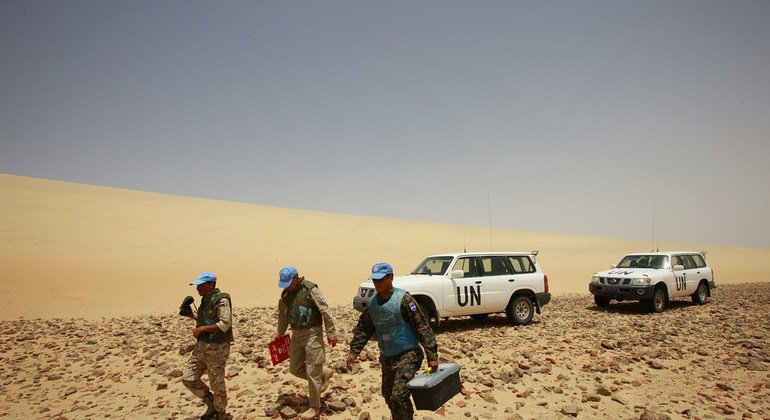
Over time the mission's day-to-day work became ceasefire monitoring: military observers patrolling either side of the sand berm that divides the territory, reporting violations and supporting mine clearance. When its mandate ended, MINURSO was headquartered in Laayoune, with nine team sites — four west of the berm and five east of it — plus a liaison office in Tindouf, and roughly 200 civilian staff, military observers and staff officers from more than 35 countries. (UN News)
Guterres paid tribute to the mission's personnel and to the 20 MINURSO members who lost their lives during its 35 years in the territory, recognising what he called the "central role" the mission had played in monitoring the ceasefire and creating conditions for a political solution.
The mission's end follows a difficult few years for the ceasefire itself. The POLISARIO declared in 2020 that it no longer considered itself bound by the truce, after a dispute over the Guerguerat crossing, and low-level hostilities have continued since. The Council's failure to renew the mandate therefore removes the UN's eyes on the ground at a moment when the ceasefire is already under strain — a point that will worry troop-contributing countries and regional diplomats alike.
Why the Council could not agree
The deadlock was not simply about the length of an extension; it was about the direction of the political process. The US draft would have renewed and restructured the mission, dropping the referendum reference from its name, and would have consolidated the Council's backing for autonomy under Moroccan sovereignty as the basis for a settlement — a position the Council endorsed in a resolution a year ago as the "most feasible" solution. (Reuters)
Russia, which abstained in last year's vote, vetoed the new text, arguing that it prejudged the outcome of negotiations and sidelined the principle of self-determination. Its own alternative — a straightforward one-year extension of the existing mandate to 31 October 2027 — drew only three votes in favour, one against and 11 abstentions, and was defeated. The result was the worst outcome for the mission itself: no mandate at all.
The split reflects a wider shift in the diplomacy of the dispute. A growing number of states have backed Morocco's autonomy plan in recent years, while Algeria, which supports the POLISARIO, insists that any settlement must be based on self-determination. The Council's inability to bridge that gap this week has now cost the UN its longest-running peacekeeping presence in the region — a precedent that other missions facing renewal fights will watch closely.
What happens now
Sunday marks the start of the liquidation period. A smaller team reporting to the UN Department of Operational Support will oversee the disposal of UN equipment, the repatriation of assets belonging to troop-contributing countries, and the management of UN-owned property under established procedures. (UN News)
The end of peacekeeping operations does not remove the issue from the Security Council's agenda, and it does not end the UN's diplomatic involvement. De Mistura's mediation continues, and the Council is expected to return to the file — the question is whether members can agree on a successor arrangement, or whether the dispute will now be managed without any UN field presence at all.
Reactions on Sunday split along familiar lines. Morocco, which claims the territory as its own, welcomed the outcome, while the POLISARIO expressed concern about the loss of the ceasefire monitors. For the people of the territory, the practical change is immediate: the blue helmets that patrolled the berm for a generation are going home, and the buffer they provided goes with them.
The closure also matters beyond Western Sahara. MINURSO was one of the UN's oldest missions, and its unplanned end — by expiry rather than by a deliberate decision to withdraw — is a warning about how great-power disagreement in the Council can dismantle field operations by default. Whether the Council can rebuild a consensus around a new arrangement will be the first test of whether the political process survives the loss of its peacekeepers.
For background on how the mandate reached this point, see our earlier coverage of the failed renewal resolutions and the Secretary-General's report on a transitional council.
Key takeaways
- MINURSO's mandate expired at midnight on 31 October 2026 after the Security Council failed to renew it, ending 35 years of UN peacekeeping in Western Sahara.
- A US draft backed by 11 members was vetoed by Russia; a rival Russian draft won only three votes and was defeated.
- A liquidation phase began on 1 November, with a smaller UN team overseeing the withdrawal of personnel and equipment.
- Secretary-General Guterres said the mission's end does not remove the people's right to self-determination, and mediation through his Personal Envoy continues.
- The closure removes ceasefire monitors at a time when the 1991 truce is already under strain, raising the stakes for the political process.
Frequently Asked Questions
What was MINURSO?
MINURSO, the UN Mission for the Referendum in Western Sahara, was established in 1991 to monitor the ceasefire between Morocco and the Frente POLISARIO and to organise a referendum on the territory's future. The referendum never took place because the parties could not agree on voter eligibility, so the mission's main work became ceasefire monitoring and mine action.
Why did the mission end?
Its mandate expired at midnight on 31 October 2026 after the Security Council failed to adopt any renewal. A US-drafted resolution was vetoed by Russia, and a competing Russian resolution failed to win the nine votes needed for adoption, leaving the mission without a legal basis to continue.
What happens to UN staff and equipment now?
A liquidation phase began on 1 November 2026. A reduced team reporting to the UN Department of Operational Support is overseeing the orderly withdrawal of personnel, the return of equipment belonging to troop-contributing countries, and the disposal of UN-owned property.
Does the end of MINURSO mean the UN is leaving the Western Sahara issue?
No. Secretary-General António Guterres said the UN remains committed to a just, lasting and mutually acceptable political solution, and mediation continues through his Personal Envoy, Staffan de Mistura. The issue also remains on the Security Council's agenda.
How long had MINURSO been in Western Sahara?
Thirty-five years. The mission was established under Security Council resolution 690 in 1991, following the ceasefire that ended 16 years of conflict, and operated continuously until its mandate expired in 2026.