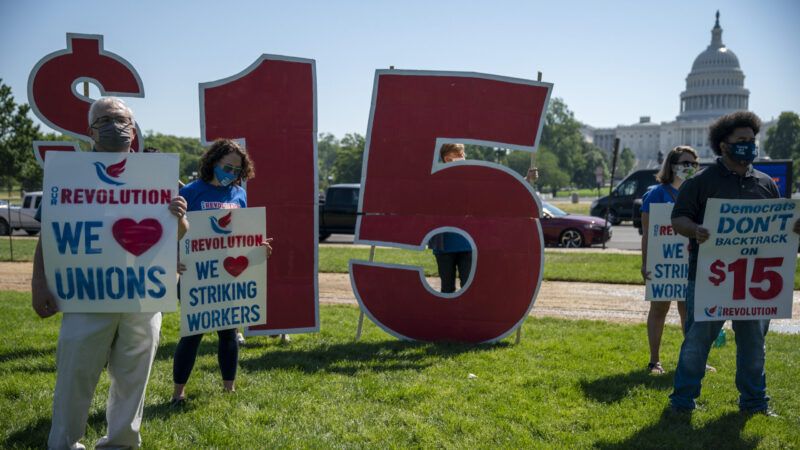
A group of 17 US lawmakers has ramped up calls for Congress to raise the federal minimum wage to $25 an hour and abolish the separate subminimum wage for tipped workers, reviving a bill that has sat idle since April. The push, led by the sponsors of the Living Wage For All Act, would end the longest freeze in the history of the federal wage floor — $7.25 an hour since 2009 — and comes as Democrats prepare to take control of both chambers in the new Congress. Al Jazeera
The group includes current and newly elected House members. Brad Lander, a congressman-elect from Brooklyn, New York, said he would join the bill as a co-sponsor when the next congressional session begins in January. The legislation's original lead sponsors are Representative Delia Ramirez of Illinois, Representative Jesus "Chuy" Garcia, also of Illinois, and Representative Analilia Mejia of New Jersey.
What the bill would do
The Living Wage For All Act, introduced in the House as H.R. 8555 on April 28, 2026, with 35 co-sponsors, and in the Senate as S. 4981 on July 14, 2026, by Senator Chris Murphy of Connecticut, would raise the federal minimum wage to $25 an hour on a phased schedule — and then keep it moving, so it can never freeze again. Living Wage For All
Under the bill, the wage floor would rise to $12 an hour in the first year after enactment. Larger employers — those with more than 500 employees nationwide or at least $1 billion in annual revenue — would reach $25 by 2031. Smaller employers would have until 2038. After that, the floor would be indexed to two-thirds of the national median wage, ending the pattern of decades-long freezes by design.
Just as important for its supporters is what the bill removes. It would eliminate every subminimum wage in federal law: the $2.13 an hour rate for tipped workers, frozen since 1991, as well as lower rates for workers with disabilities, young workers and incarcerated workers. Tipped workers would earn the full minimum wage, with tips on top. One Fair Wage
Who it would affect
The federal minimum wage has been stuck at $7.25 since July 24, 2009 — the longest stretch without a raise since the wage floor was created in 1938. Only about 843,000 workers, or 1.0 percent of hourly workers, earn at or below that rate today, according to Bureau of Labor Statistics data for 2024. But the bill's supporters say that figure understates the problem: seven million Americans are paid below the federal minimum by law under the various subminimum-wage exemptions, and the Economic Policy Institute counts 14 million workers earning under $15 an hour and 42 million under $20.
A full-time worker on $25 an hour would earn $52,000 a year — just above the median American worker's pay of $24.51 an hour. For supporters, that is the point: the proposal is framed not as a raise for a small group at the bottom, but as a floor that keeps pace with what a typical American worker already earns. As Chronicle reported on the affordability squeeze, the cost of rent, groceries, health care, transport and child care has climbed steadily while the federal floor stood still.
The states, meanwhile, have moved on their own. Thirty states and the District of Columbia now set minimum wages above the federal floor. Washington, DC, has the highest of any US jurisdiction, at $18.40 an hour, followed by Washington state at $17.13. The National Employment Law Project reports that 88 jurisdictions are raising wage floors during 2026 — evidence, supporters say, that communities are already acting where Washington has not. The pressure is global: as Chronicle reported, garment workers in Bangladesh shut factories in wage protests this month, part of a worldwide push for pay that keeps up with living costs.
The politics: a new majority, an old fight
The timing is deliberate. The push comes as Democrats prepare to take control of both the House and Senate in the new Congress, giving the bill its first realistic path to a vote. The last major attempt to raise the federal minimum wage came during former President Joe Biden's first year in office, and it failed.
The bill's backers, a coalition of more than 100 organisations including the Service Employees International Union, the American Federation of Teachers, the National Education Association and the NAACP, argue that the political ground has shifted. Voters have repeatedly backed wage increases at the ballot box, and the cost-of-living pressures that dominated the last election cycle have made the frozen $7.25 a symbol of a Washington that stopped keeping up.
The opposition case — and the missing numbers
Critics argue the proposal is far more ambitious than anything the government has ever modelled. The Congressional Budget Office has never estimated the effects of a $25 minimum wage; its interactive model of minimum-wage effects offers target options only from $12 to $17. The $25 figure is, in the words of one analysis, literally off the government's chart. PHXTri
Opponents also point to recent votes. Oklahoma voters rejected a ballot measure that would have raised the state's minimum wage from $7.25 to $15 an hour by a 55 percent to 45 percent margin earlier this year. California voters rejected an $18 minimum wage measure, and Massachusetts voters rejected a $15 floor for tipped restaurant workers, both in 2024. And a survey cited by the industry-backed group MinimumWage.com found that 84 percent of surveyed economists said proposals like the $25 wage would make the cost of living worse. MinimumWage.com
That survey, and the ballot defeats, are the strongest cards the opposition holds — but they also reveal a gap in the debate. Neither side has an authoritative estimate of what a $25 floor would actually cost employers or do to employment, because no official body has scored it. The bill's supporters say the phased timeline — up to twelve years for small employers — is the answer to the cost question. Critics say a phase-in does not change the destination.
Why this time may be different
The wage fight has a long history in American labour politics — Chronicle marked the death in October of Dolores Huerta, the 96-year-old labour and civil rights icon whose organising helped define the movement. What is new this time is the scale of the demand and the breadth of the coalition behind it: not a modest bump to $12 or $15, but a $25 floor, indexed forever, with no carve-outs.
The bill has been introduced in both chambers but has not passed into law, and it still needs action in committee before it can reach a floor vote. Whether the new Democratic majorities spend their early political capital on it — alongside the other items on their agenda — will be the first real test of the push. For the workers the bill is aimed at, the more immediate fact is simpler: the wage floor has not moved in seventeen years, and the campaign to move it has just got louder.
Frequently Asked Questions
What is the Living Wage For All Act?
The Living Wage For All Act (H.R. 8555 in the House, S. 4981 in the Senate) is a federal bill that would raise the US minimum wage to $25 an hour and end every subminimum wage — for tipped workers, youth workers, workers with disabilities and incarcerated workers. It was introduced in the House on April 28, 2026, by Representative Delia Ramirez, and in the Senate on July 14, 2026, by Senator Chris Murphy.
How fast would the wage reach $25?
The bill phases the increase in over several years. The floor would rise to $12 an hour in the first year after enactment. Large employers — those with more than 500 employees or at least $1 billion in annual revenue — would reach $25 by 2031. Smaller employers would have until 2038. After that, the wage would be indexed to two-thirds of the national median wage.
What is the tipped wage, and why does the bill end it?
The federal subminimum wage for tipped workers is $2.13 an hour, unchanged since 1991. Employers are supposed to make up the difference if tips fall short of the full minimum, but supporters of the bill say the system leaves millions of workers dependent on tips for basic pay. The bill would require tipped workers to earn the full minimum wage, with tips on top.
How long has the federal minimum wage been $7.25?
Since July 24, 2009 — the longest freeze in the history of the federal wage floor, which dates to 1938. The subminimum wage for tipped workers has been frozen even longer, at $2.13 since 1991.
Has the bill passed into law?
No. It has been introduced in both chambers of Congress and has 35 House co-sponsors as of November 2026, but it has not yet passed into law. The renewed push comes as Democrats prepare to take control of both the House and Senate in the new Congress.