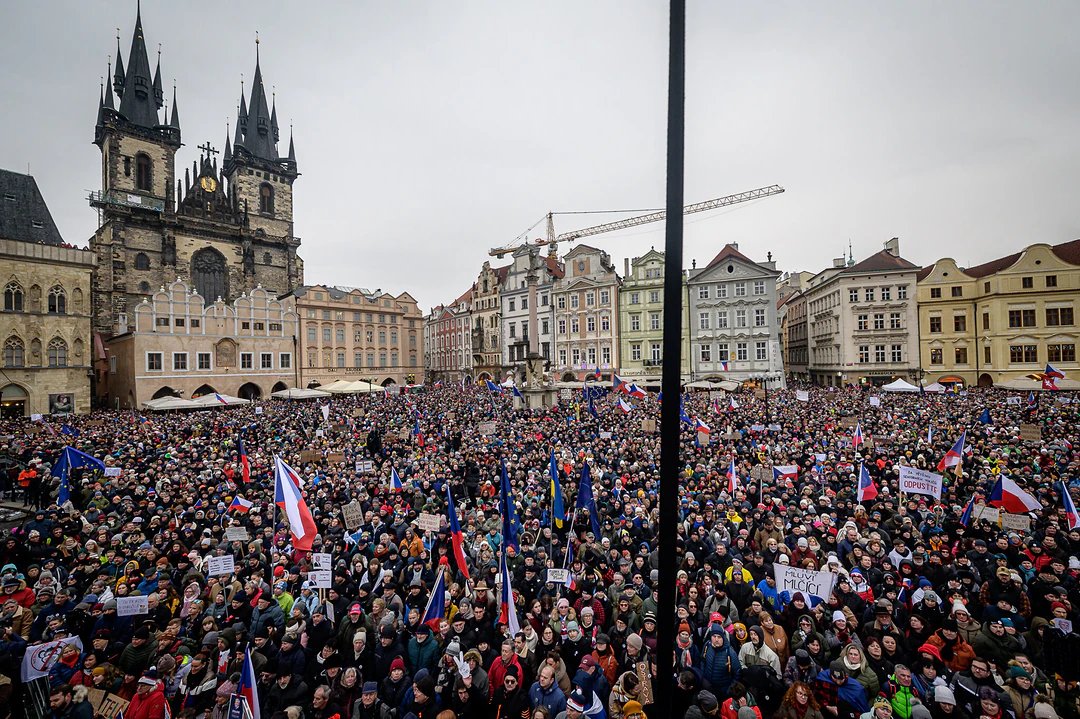
Thousands of protesters packed Prague's historic Old Town Square on Sunday, October 25, 2026, after government lawmakers gave initial backing to a sweeping overhaul of public media funding in a rare overnight parliamentary vote that critics say could leave Czech Television and Czech Radio exposed to political pressure. The demonstration, one of the largest public media protests the country has seen in years, was fuelled less by the funding formula itself than by the way the bill reached the floor: unexpectedly, outside the planned order of business, with debate curtailed and a vote scheduled for the small hours of Saturday morning, according to Reuters.
Smaller protests had already broken out on Friday, when the bill was unexpectedly introduced. By Sunday, the mood in the square had hardened into open defiance, with chants of "Resignation" and "We've had enough" rolling across the cobblestones. Organisers promised further protests as the legislation moves into its committee stage, setting up a running confrontation between the government and a public that, by most measures, still trusts its public broadcasters a great deal.
Table of Contents
- A vote at 4:36 in the morning
- What the overhaul would actually change
- Why the government says it is necessary
- Why critics see a threat to independence
- A broadcaster the public still trusts
- The European backlash
- The president weighs in
- What happens next
- Key takeaways
- Frequently Asked Questions
- Sources
- Chronicle related reading
A vote at 4:36 in the morning
The sequence of events is what turned a technical funding debate into a street protest. The proposal's first reading was brought to the lower house floor on Friday outside the planned order of proceedings, catching opponents and media advocacy groups by surprise. The Speaker of the lower house, Tomio Okamura of the far-right SPD party, limited debate and scheduled the vote for 4:36 a.m. on Saturday — a timing that protest leaders have seized on as evidence that the government wanted as little scrutiny as possible.
"Mr Babis ... Mr Okamura, nobody in this country believes that your intention was pure," protest leader Mikulas Minar told the crowd on Sunday, directing his criticism squarely at Prime Minister Andrej Babis and the Speaker. "(This protest) is a clear message to this government: you have really gone too far this time," he added, as reported by Reuters.
The overnight timetable matters politically because it undercuts the government's own framing. A reform presented as a routine matter of funding transparency does not usually need to be pushed through while most of the country is asleep. For the opposition, the hour of the vote has become shorthand for the whole process: rushed, opaque, and dismissive of dissent.
What the overhaul would actually change
At its core, the legislation would abolish the household fees that currently fund Czech Television and Czech Radio and replace them with money from the state budget. On paper, that sounds like a simplification. In practice, critics argue, it changes who holds the purse strings — and therefore who holds leverage over the broadcasters.
Under the current system, licence-style household fees give the two broadcasters a revenue stream that is, at least in principle, insulated from the annual political bargaining of the budget process. Under the proposed system, their funding would be decided by the government of the day, year by year, in the same process that funds ministries and agencies. The proposal would also cut funding for Czech Television and Czech Radio by about 15%, possibly as early as next year.
The bill has passed only its first reading and is now at the committee stage, before a later vote. That means the details — the size of the budget allocation, any safeguards, and the transition timetable — are still open to amendment. But the direction of travel is clear, and it is that direction, as much as any single figure, that has alarmed media freedom advocates.
Why the government says it is necessary
Prime Minister Andrej Babis, the billionaire populist whose government is backed by the far-right SPD, has rejected the charge that the reform is an attack on media independence. He has framed it instead as a matter of funding transparency — a cleaner, more accountable way of paying for public broadcasting than a fee system that many governments across Europe have been reconsidering.
That argument is not without precedent. Several European countries have debated moving public broadcasters onto direct budget funding, and supporters argue that a fee collected from every household can feel anachronistic in an era of streaming and fragmented viewing. The government also notes, implicitly, that the reform does not touch editorial staffing or programming decisions directly.
Yet the government's credibility on media issues is part of the problem for its critics. Babis's government has frequently clashed with public and private media, and the SPD's own history of hostile rhetoric towards journalists means that even a technically neutral funding change is read, by many Czechs, through a lens of suspicion.
Why critics see a threat to independence
The critics' case rests on a simple institutional logic: a broadcaster that depends on an annual government allocation is a broadcaster that must think twice before embarrassing that government. Even without any explicit interference, the argument goes, the incentive structure changes — editors and managers become more cautious, controversial investigations get softer treatment, and the public gradually receives a less challenging service.
Opposition parties have drawn an explicit comparison with Hungary, where former Prime Minister Viktor Orban oversaw a major expansion of pro-government media and a consolidation of outlets sympathetic to his Fidesz party. The comparison is contested — the Czech media landscape remains far more plural than Hungary's — but it captures the fear that funding reform is the first step on a longer road, not an isolated technical fix.
The funding cut sharpens the point. A reduction of roughly 15% would force real choices about programming, staffing, and regional coverage at a moment when the broadcasters are also being asked to defend their independence. Critics argue that a government genuinely interested in strengthening public media would not begin by shrinking it.
A broadcaster the public still trusts
What makes this confrontation unusual is the standing of the institutions at its centre. Czech Television is the country's most-watched broadcaster across major age groups, and public media rank among the most trusted news sources in the country, according to a 2025 Reuters Institute survey. In many European media debates, public broadcasters fight funding battles from a position of declining audiences and eroding trust. In the Czech Republic, the opposite is true: the broadcasters are popular, and the government is picking a fight with an institution that many voters feel protective of.
That popularity helps explain the scale of Sunday's protest. Demonstrations about media funding formulas rarely fill historic squares. Demonstrations framed as a defence of a trusted national institution, pushed through in the middle of the night, do. The crowd in Old Town Square was not debating accounting methods; it was signalling that it regards Czech Television and Czech Radio as part of the country's democratic furniture, not as just another budget line.
The European backlash
The controversy has already spilled beyond the Czech Republic's borders. On Friday, the European Broadcasting Union, together with 15 other groups including other public broadcasters and Reporters Without Borders, called for more debate and for the removal of any measures threatening the broadcasters' financial sustainability. The joint intervention matters because it frames the Czech reform not as a domestic budgetary choice but as a test of European media freedom standards.
Brussels has spent recent years building a framework — including the European Media Freedom Act — designed to protect public service media from political capture, precisely through safeguards on funding and governance. A member state moving its public broadcasters onto direct state funding, with a simultaneous cut, is likely to attract scrutiny under that framework, even if the Czech government insists its motives are purely administrative.
For Prague, the European dimension cuts both ways. It raises the political cost of pushing the reform through unchanged, but it also gives the government a convenient foil: it can present outside criticism as interference in a sovereign budgetary decision.
The president weighs in
President Petr Pavel, a former NATO general who has positioned himself as a guardian of democratic institutions, also entered the debate, calling on Saturday for more expert scrutiny of the proposals. "The Czech Republic is among the few countries in central and eastern Europe where the system of public service and private media works very well," he said on X, as reported by Reuters.
Pavel's intervention is significant because of his office's constitutional role. The Czech president does not control the legislative agenda, but he can return legislation to parliament and shape public debate, and his words carry weight with voters who see him as standing above party politics. His emphasis on the system working well is a pointed rebuke to the government's implied case that the funding model is broken and in need of urgent repair.
What happens next
The bill now goes to committee, where the government will face its first real test of whether it can hold its majority behind the current text or will be forced into concessions. Several paths are open: the committee could soften the funding mechanism, add statutory safeguards for editorial independence, phase in the change more slowly, or reduce the size of the cut. Alternatively, the government could try to push the bill through largely unchanged, betting that public anger fades and that the parliamentary arithmetic holds.
The protest movement, meanwhile, has promised to keep up the pressure, and its leaders will be watching the committee stage closely. If further large demonstrations follow, the government may find that a reform it presented as a technical fix has become a defining political fight — one that forces voters to choose between a government they elected and broadcasters they trust.
The broader lesson reaches beyond Prague. Across Europe, the funding of public service media is becoming one of the sharpest tests of democratic resilience: not because governments openly censor, but because the quiet mechanics of budgets, appointments, and funding formulas can hollow out independence just as effectively. The crowd in Old Town Square understood that. Whether the government does remains to be seen.
Key takeaways
- Thousands of protesters filled Prague's Old Town Square on Sunday, October 25, 2026, after lawmakers backed a public media funding overhaul in an overnight vote.
- The bill would abolish household fees funding Czech Television and Czech Radio, replacing them with state budget funding and cutting their budgets by about 15%.
- Critics say budget funding would leave the broadcasters vulnerable to political pressure; Prime Minister Andrej Babis says the change is about funding transparency, not independence.
- The European Broadcasting Union, 15 other groups, and Reporters Without Borders called for more debate and the removal of measures threatening the broadcasters' sustainability.
- President Petr Pavel called for more expert scrutiny, noting that the Czech public-private media system works very well.
- The bill is now at committee stage before a later vote, and organisers plan further protests.
Frequently Asked Questions
What is the Czech public media overhaul about?
The Czech government has proposed abolishing the household fees that currently fund Czech Television and Czech Radio and replacing them with funding from the state budget. The proposal would also cut the broadcasters' funding by about 15%, possibly as early as next year. The bill passed its first reading in an overnight vote and is now at committee stage.
Why are protesters worried about state budget funding?
Critics argue that a broadcaster funded through the annual state budget depends on the goodwill of the government of the day, which creates pressure — even if unspoken — to avoid embarrassing that government. They say household fees, by contrast, give the broadcasters a revenue stream that is more insulated from political bargaining. The government rejects this, saying the reform is about transparency, not control.
Who protested in Prague, and what did they demand?
Thousands of people gathered in Prague's Old Town Square on Sunday, October 25, 2026, with smaller protests having taken place on Friday. Led by figures including Mikulas Minar, they chanted "Resignation" and "We've had enough" and demanded that the government abandon or substantially rethink the overhaul. Organisers say further protests are planned.
What has the international reaction been?
The European Broadcasting Union, along with 15 other groups including other public broadcasters and Reporters Without Borders, called for more debate and the removal of any measures threatening the broadcasters' financial sustainability. President Petr Pavel also called for more expert scrutiny, praising the Czech media system as one that works very well.
What happens next for the bill?
The bill is at the committee stage in the lower house, before a later vote. Amendments could soften the funding mechanism, add independence safeguards, or change the size and timing of the cut. The outcome will depend on whether the government holds its majority and how sustained the public protests prove to be.
Sources
- Reuters — Thousands protest Czech government's public media overhaul after rushed vote, October 25, 2026.