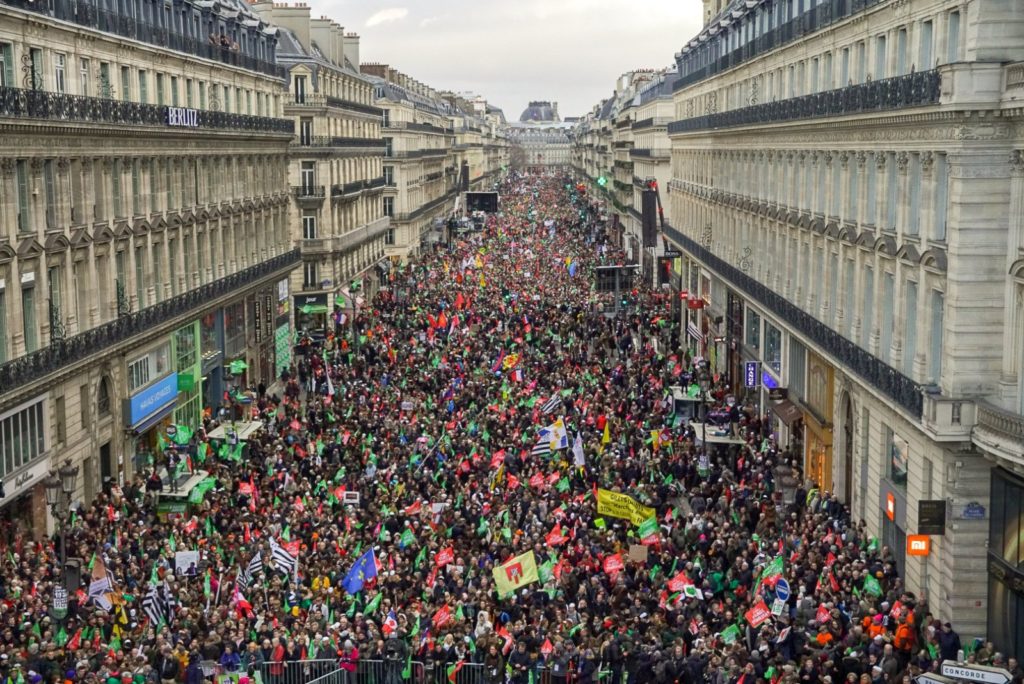
Tens of thousands of public sector workers marched across France on Tuesday in the third united strike since September, demanding pay rises that Prime Minister Sébastien Lecornu's government says it cannot afford — but the crowds were markedly smaller than at earlier mobilisations, raising questions about how long the movement can sustain its pressure. (Reuters)
The Interior Ministry counted 146,000 demonstrators nationwide, including 28,000 in Paris, where the main march set off from Place de la Nation in the afternoon and headed for Place d'Italie. Police had expected between 220,000 and 300,000 people across the country. The demonstrations were largely peaceful, a contrast with the clashes and tear gas seen at an earlier mobilisation this month, when hundreds of thousands took to the streets.
France's 5.8 million public sector employees — teachers, nurses, civil servants, rail workers and local government staff — were called out by the unions after talks with Lecornu on Friday failed to satisfy their core demand: an across-the-board pay rise, starting with the unfreezing of the index point that sets civil servants' basic salary. High school and university students joined the marches, as did Yellow Vest activists, in a protest movement that has now been rolling for more than a month, fuelled by school blockades and anger over the cost of living.
A government offer the unions call derisory
The dispute turns on a single number. The unions want the pay scale point unfrozen so that every civil servant gets a real-terms rise. The government's draft 2027 budget rules out any general pay rise for the fourth consecutive year, and ministers say the state has no room to offer more while it tries to cut the deficit.
Government spokesperson Mathieu Lefèvre described Friday's offer as a "very concrete response": a guarantee that no civil servant earns less than the minimum wage, with targeted raises of up to 650 euros gross for more than 1.3 million of the lowest-paid staff. The unions were unimpressed. Sophie Binet, leader of the CGT, one of the main unions behind the strike, said the only answer so far amounted to five more euros a month on the minimum wage.
That gap — between a government offering targeted help to the lowest paid and unions demanding a rise for everyone — is the heart of the standoff. The unions argue that four years without a general rise, while prices have climbed, amounts to a steady pay cut. The government argues that the public finances, already under pressure from markets and from Brussels, cannot absorb a blanket increase for nearly six million people.
Disruption, but not paralysis
The strike disrupted transport without bringing the country to a halt. National rail operator SNCF reported minor to major disruption on regional TER services and on the RER D commuter line in the Paris region, and several central metro and RER stations closed from late morning. Schools were affected in places, and some public services ran reduced hours — but the day did not produce the near-total shutdown the unions had hoped for, and the lower turnout will be read in Paris as a sign that the movement's momentum is ebbing.
That reading matters because the calendar is unforgiving. France is racing to adopt its 2027 budget under pressure to reduce the deficit, and the strike comes less than five months before a presidential election in which the far right hopes to win power. Lecornu, who has been battling to keep his government afloat since taking office amid the school protest movement that has shaken his premiership, cannot afford either a climbdown that blows a hole in the budget or a confrontation that re-ignites the street movement.
A movement spreading beyond France
The French protests are no longer a purely French affair. Similar demonstrations have taken place in other European countries, in part inspired by the French movement, and on Tuesday several thousand demonstrators — mostly students — took to the streets in Brussels to protest deteriorating conditions at schools, budget cuts and rising university tuition fees. The unrest has become a shared European story about squeezed public services, rising living costs and governments struggling to balance their books, a pattern already visible when protests spread from France to Italy in October.
For the unions, the question now is what comes next. A third day of action with falling numbers risks looking like a movement running out of steam — but the grievances behind it have not gone away. The pay freeze remains, the budget is still to be passed, and the school blockades that started the autumn of protest continue in places. The unions have not announced a fourth date, but Binet and her counterparts have made clear they do not regard the dispute as settled, and the government knows that a single spark — a tough budget vote, a heavy-handed policing incident — could refill the streets.
What happens next
The immediate test is the budget. If parliament passes a 2027 budget that keeps the pay freeze in place, the unions will have to decide whether to escalate with longer or rolling strikes, or to accept that this round is over and regroup for the election campaign, when pay and public services will be central issues. Lecornu, for his part, will be judged on whether he can hold the line on spending without triggering the kind of mass mobilisation that defined the autumn — the hundreds of thousands who marched earlier this month are a reminder of what the streets can still deliver.
For now, Tuesday's marches ended peacefully and the government held its ground. But with the presidential election approaching and the cost-of-living anger undimmed, neither side can claim the dispute is finished. The strike may have been smaller; the problem it was about has not shrunk at all.
Frequently Asked Questions
Why did French public sector workers strike on 17 November 2026?
Unions called a nationwide strike to demand across-the-board pay rises, above all the unfreezing of the index point that sets civil servants' basic salary. Talks with Prime Minister Sébastien Lecornu the previous Friday failed to satisfy them, and the government's draft 2027 budget rules out a general pay rise for the fourth year in a row.
How many people took part in the protests?
The Interior Ministry counted 146,000 demonstrators across France, including 28,000 in Paris. That was down sharply from earlier mobilisations this autumn, when hundreds of thousands marched, and below the 220,000 to 300,000 police had expected.
What did the government offer the unions?
The government offered a guarantee that no civil servant earns less than the minimum wage, with targeted raises of up to 650 euros gross for more than 1.3 million of the lowest-paid staff. Unions rejected it as insufficient, with CGT leader Sophie Binet saying it amounted to about five euros a month on the minimum wage.
Was the strike disruptive?
Yes, but not paralysing. Rail services were disrupted, particularly regional TER trains and the RER D line around Paris, several central metro and RER stations closed from late morning, and some schools and public services ran reduced hours. The marches themselves were largely peaceful.
What happens next in the dispute?
The focus now shifts to the 2027 budget vote in parliament. If the budget passes with the pay freeze intact, unions must decide whether to escalate with further action or regroup ahead of the presidential election, when pay and public services will be central campaign issues.