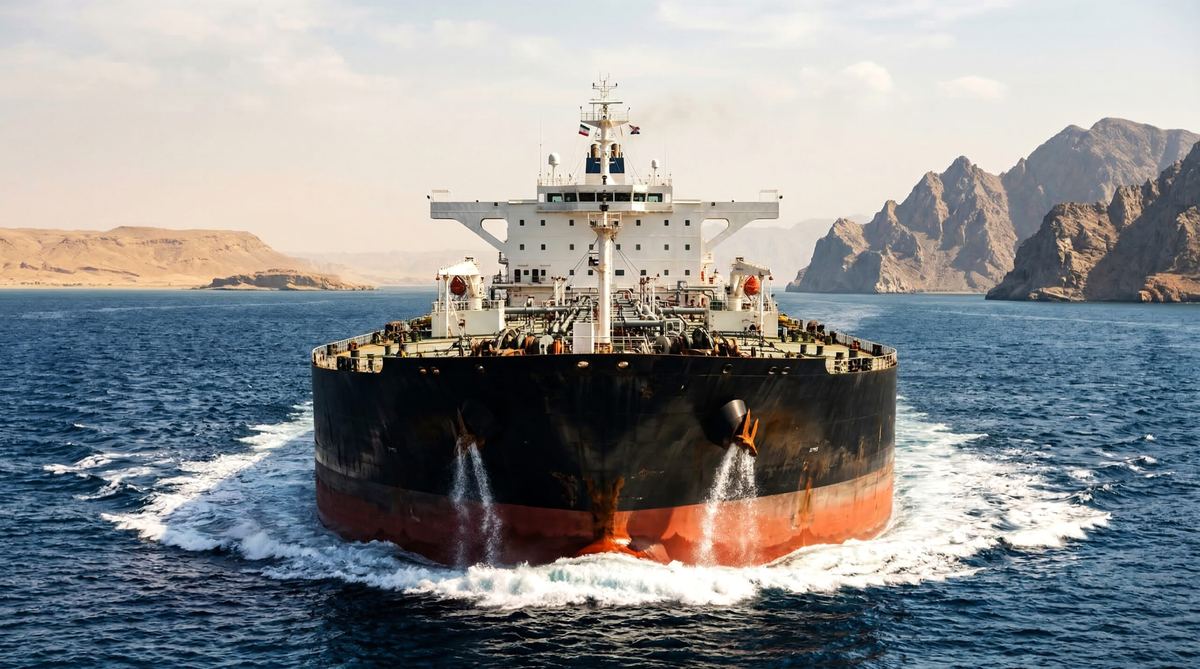
Some of the most dangerous work in shipping is now also among the best paid. With detectable traffic through the besieged Strait of Hormuz at its lowest level since July and attacks on tankers running at their highest intensity since the US-Israel war on Iran began, tanker captains are being offered base salaries of up to $100,000 plus $50,000 bonuses for every voyage through the waterway, according to the Financial Times, as reported by Al Jazeera. Crews as a whole can earn four to six times their normal salaries for making the crossing.
Contents
- The figures behind the hazard pay
- A strait gone quiet — except for the shadows
- How crews run the gauntlet
- The industry's grim arithmetic
- What it means for oil prices
- Frequently Asked Questions
- Sources
- Further reading
The figures behind the hazard pay
The numbers circulating in maritime recruitment channels are striking. Per the Financial Times reporting cited by Al Jazeera, some captains can now command a base salary of $100,000 — already the high end of normal pay, which varies widely between companies — topped with a $50,000 bonus for each single trip through the strait.
The premium extends down the ranks. The Wall Street Journal reported this week that a staffing company in China's Shandong province is offering up to $25,000 for a single round trip — a sum that, for oilers and cadets at the bottom of the ship's hierarchy, can represent more than a year of ordinary wages. Many of the sailors willing to take the risk are coming from India, the Philippines and China, according to the report.
For the shipping companies themselves, the economics are brutal at every level. The Journal reported that firms are spending between $30 million and $40 million for a single round trip to move oil in and out of Hormuz using ship-to-ship transfers. Oil producers, meanwhile, have to absorb extreme logistics costs to get their crude out of the waterway, with shipowners and individual sailors making what the report described as some of the best returns the industry has seen in decades.
A strait gone quiet — except for the shadows
The pay explosion reflects a simple reality: fewer ships are crossing, and those that do are operating in the dark. Shipping data from Kpler shows only seven detectable vessels passed through the strait in the past week — the lowest figure since 23 July. Yet the picture is deliberately murky: many smaller shuttle boats switch off their transponders to avoid detection before offloading oil to larger tankers waiting beyond the strait.
Despite the violence, oil is still getting out. Kpler data cited by Al Jazeera shows at least 16.5 million barrels a day left the region last month, matching the pre-war average when Iran — now under a US naval blockade — is excluded. About 40 per cent of those exports bypass the strait altogether, flowing through Saudi Arabia's East-West pipeline to the Red Sea port of Yanbu or moving on small shuttle vessels conducting risky ship-to-ship transfers.
The danger, however, keeps escalating. On Wednesday night, the United Kingdom Maritime Trade Operations (UKMTO) reported several casualties after multiple projectiles struck a vessel sailing off Qatar's northern coast. Since the US-Israel war on Iran began in late February, Tehran has all but closed the strait to vessels without its express clearance, striking ships that cross unauthorised; Washington has responded with a naval blockade on Iranian ports and escorts for some vessels. Saul Kavonic, energy head at MST Marquee, told Reuters that "the frequency of Iranian attacks on ships is now at the highest point since the war began, and likely to intensify further."
How crews run the gauntlet
Accounts from sailors describe transits that look more like covert operations than commercial shipping. Captains on the larger ships turn off their lights and transponders; one captain who spoke to Bloomberg described strict instructions on his shuttle runs — no lights, no phones, only one radar on — navigating by coastline and lighthouses. He called the experience "quite challenging." After spotting a fire ahead on one trip, he radioed the US Navy, which has been assisting ships to avoid mines, to warn them of an attack.
Crew members barricade the main decks with sandbags against drones and missiles, according to the reports. Shipping executives estimate a one-in-20 chance of being hit while crossing at present — odds that explain why crews are insisting on hazard pay at multiples of their normal wages, and why one captain signed only a shorter-than-usual contract, telling Bloomberg the voyage was "not easy" even as he collected several times his usual salary.
The industry's grim arithmetic
The economics of the Hormuz bonus reveal how thoroughly the war has rewired global energy logistics. Before the conflict, roughly a fifth of the world's oil and liquefied natural gas passed through the strait; now the trade moves through a patchwork of pipelines, dark-running shuttle boats and transponder-off tankers. Saudi Arabia's East-West pipeline, which carries crude from the kingdom's eastern fields to Yanbu, has been crucial — though it too has come under threat and been forced to shut at times due to strikes by Iran-backed groups.
For producers and traders, the strait has become a tax that is passed on to everyone. "Constrained product flows, extreme logistics costs and high likelihood of Iranian escalation are keeping [oil] prices elevated," Kavonic told Reuters.
What it means for oil prices
Oil prices rose on Thursday morning as the latest attacks fed supply anxiety: Brent crude futures gained $2.28, or 2.28 per cent, to $102.28 a barrel, while US West Texas Intermediate climbed 1.88 per cent to $89.94, per Al Jazeera's market coverage. Analysts caution that while headline export volumes look resilient, the hidden costs — hazard pay, $30–40 million round trips, rerouted pipelines — are baked into every barrel, and any further escalation could send the thin cushion of spare capacity spiralling.
Frequently Asked Questions
How much are sailors being paid to transit the Strait of Hormuz?
Some tanker captains are being offered base salaries of up to $100,000 plus a $50,000 bonus per voyage through the strait, according to Financial Times reporting. Overall, crews can earn four to six times their normal salaries, and junior crew members may receive payouts worth more than a year of wages.
How dangerous is the Strait of Hormuz for shipping right now?
Attacks on vessels are at their highest level since the US-Israel war on Iran began in late February, according to analysts. Shipping executives estimate a one-in-20 chance of being hit per crossing, and the UK Maritime Trade Operations reported several casualties after projectiles struck a vessel off Qatar's coast this week.
Is oil still getting through the strait?
Yes. About 16.5 million barrels a day left the region last month, matching the pre-war average excluding Iran. Roughly 40 per cent of exports now bypass the strait via Saudi Arabia's East-West pipeline to the Red Sea or through ship-to-ship transfers by small boats running without transponders.
Why are oil prices rising?
Brent crude reached $102.28 a barrel on Thursday on fears of supply disruption. Analysts cite constrained product flows, extreme logistics costs from rerouted exports and hazard pay, and the risk of further Iranian escalation as the drivers keeping prices elevated.
Sources
- Al Jazeera — "The Hormuz bonus: Sailor salaries soar for transits amid Iran war"
- Financial Times (via Al Jazeera) — tanker captain salary and per-voyage bonus reporting
- The Wall Street Journal (via Al Jazeera) — ship-to-ship transfer costs and recruitment payouts
- Reuters (via Al Jazeera) — MST Marquee analyst comments on attack frequency