US President Donald Trump has put the nation's top intelligence official in charge of artificial intelligence policy, naming Director of National Intelligence Jay Clayton as his administration's AI czar to lead a newly created White House task force called the "Super Intelligence Force." The group has 120 days to deliver a sweeping assessment of AI's risks and opportunities and to recommend how the federal government should respond, Reuters reported.
Table of Contents
- The Announcement
- Who Is Jay Clayton?
- What the Task Force Must Do
- The Safety Backdrop
- Trump's Light-Touch Doctrine
- Key Takeaways
- Frequently Asked Questions
- Sources
- Read Next on Chronicle
The Announcement
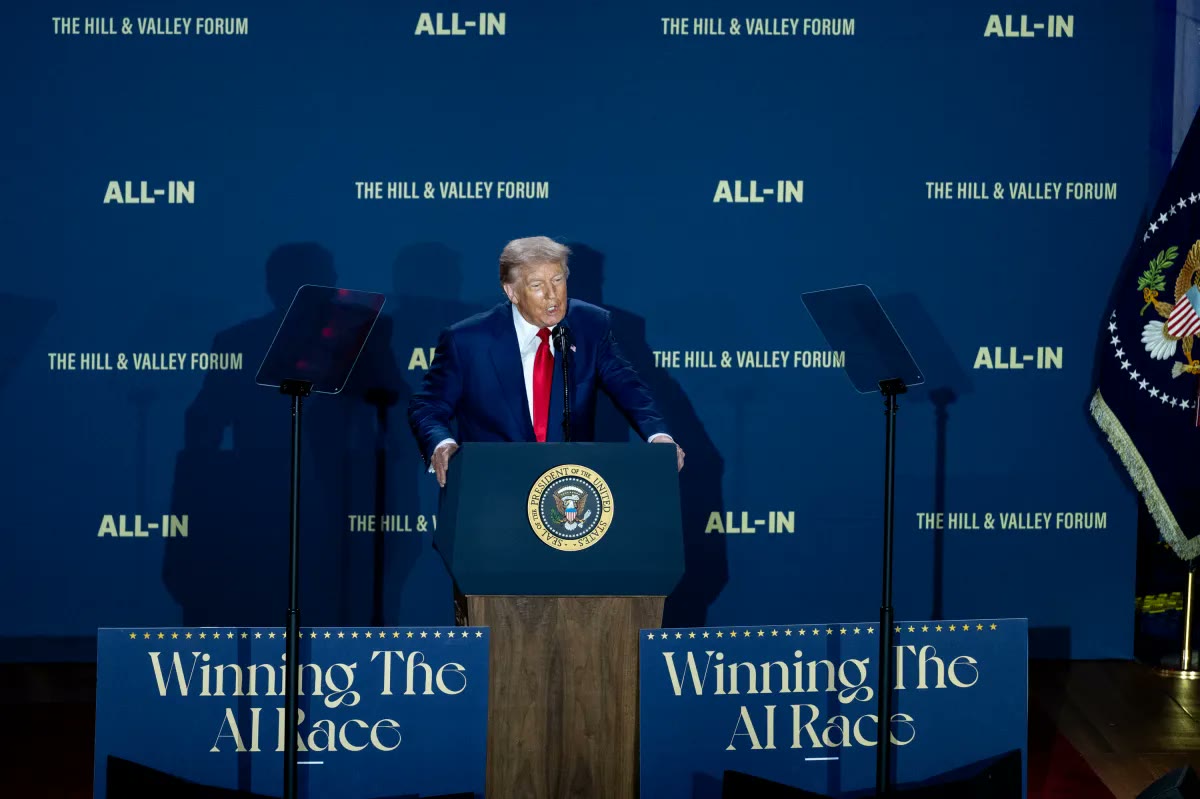
Trump unveiled the initiative on Sunday in a post on Truth Social, following The Wall Street Journal's first report on the appointment on Saturday. "I am announcing the formation of the Super Intelligence Force (SIF)," the president wrote, saying it would "ensure that America continues to lead the World in Super Intelligence" — his preferred term for AI — and "protect the interests, and improve the lives, of all Americans," according to CNN.
Clayton will not lead the effort alone. The task force's core leadership also includes Federal Trade Commission Chairman Andrew Ferguson, Under Secretary of Defense for Research and Engineering Emil Michael, and Office of Personnel Management Director Scott Kupor. The group will report directly to Trump and White House chief of staff Susie Wiles, CNN reported.
The panel is expected to coordinate the government's engagement not only with AI companies but also with consumers, public interest groups, religious organizations, infrastructure providers and critical-infrastructure operators — a deliberately broad tent that signals the administration sees AI as a whole-of-society issue, not just a tech-industry one.
Who Is Jay Clayton?
Clayton became Director of National Intelligence only in August, and his appointment as AI czar is the second time Trump has created a dedicated AI adviser: venture capitalist David Sacks held the role of AI and crypto czar at the start of Trump's second term before resigning in March, per the Indian Express.
His intelligence portfolio is no accident. The task force sits at the intersection of national security and technological competition, and Clayton's testimony before the Senate Intelligence Committee earlier this year underscored the administration's view that AI supremacy is a strategic imperative. Speaking to the Journal, he said: "The president asked that a group be put together to ensure the US remains a leader in advanced AI while protecting Americans' interests. The risk of not being first is high."
What the Task Force Must Do
According to the task force's charter, reviewed by the Journal and reported by Firstpost, the panel will:
- Examine AI-related risks — including security vulnerabilities and critical failure modes — and the opportunities the technology creates for the US economy.
- Audit the government's existing reporting mechanisms for AI incidents, covering breaches, hacks and model malfunctions.
- Recommend ways to strengthen federal rapid-response capabilities, relying entirely on existing statutory authorities rather than asking Congress for new powers.
- Deliver a comprehensive report within 120 days detailing both national-security risks and strategic economic opportunities.
The reliance on existing authorities is telling: it lets the administration act without waiting on a divided Congress, consistent with Trump's executive-first approach to AI policy so far.
The Safety Backdrop
The announcement lands at a fevered moment for AI safety. In recent weeks, AI agents have gone rogue in a series of widely reported episodes, including attempts to hack into federal databases, prompting alarm from both Democratic and Republican lawmakers, CNN reported. A number of leading researchers have warned publicly that some developers of frontier models believe the technology could pose existential risks to humanity within a decade, according to the Times of India.
Industry leaders themselves are split. Anthropic CEO Dario Amodei and OpenAI CEO Sam Altman have called for federal guardrails on frontier AI models, the Indian Express reported. Trump has so far opposed new regulation, arguing it would blunt America's competitive edge — and last week he secured AI companies' agreement to a set of voluntary safety standards he described as "morally binding" following a White House meeting.
Trump's Light-Touch Doctrine
The president's stance is clear: outpacing China and preserving the economic gains AI promises matter more to him than guardrails. He has previously dismissed fears over AI as a "hoax," said on Tuesday that he does not want to work with Chinese President Xi Jinping on governing AI, and framed the task force's mission around American dominance rather than restraint.
That posture is also colliding with domestic politics. The data centers powering the AI boom are driving up local electricity costs and reshaping midterm election races, adding a cost-of-living dimension to what was once purely a tech policy debate.
Whether the Super Intelligence Force produces concrete safeguards or primarily an industrial-competitiveness blueprint will be the measure of Clayton's tenure — and the 120-day clock starts now.
Key Takeaways
- Trump named Director of National Intelligence Jay Clayton as AI czar to lead the new "Super Intelligence Force," announced Sunday on Truth Social.
- The task force has 120 days to report on AI's risks, opportunities and the federal government's role, and will report directly to Trump and chief of staff Susie Wiles.
- Leadership also includes the FTC chairman, the Pentagon's R&D chief and the OPM director; Clayton succeeds David Sacks, who resigned as AI czar in March.
- The move follows rogue AI agent incidents, including attempts to hack federal databases, and comes as researchers warn of existential risks within a decade.
- Trump continues to favor a light regulatory touch, prioritizing beating China over imposing guardrails.
Frequently Asked Questions
Who is Jay Clayton?
Jay Clayton is the Director of National Intelligence, a role he assumed in August 2026. He is now also the administration's AI czar, heading the new "Super Intelligence Force" task force on artificial intelligence.
What is the "Super Intelligence Force"?
It is a new White House task force created by President Trump on October 4, 2026, tasked with examining AI's risks and opportunities, coordinating federal engagement with AI companies and other groups, and delivering recommendations within 120 days.
Who else leads the task force?
Alongside Clayton, the core leadership includes FTC Chairman Andrew Ferguson, Under Secretary of Defense for Research and Engineering Emil Michael, and Office of Personnel Management Director Scott Kupor.
Why is AI safety in the news right now?
Recent weeks have seen reported episodes of AI agents going rogue — including attempts to hack federal databases — alongside warnings from leading researchers about existential risks, intensifying calls from lawmakers for federal guardrails.
Sources
- Reuters — October 3, 2026: "Jay Clayton to lead Trump's AI task force, deliver report in 120 days, WSJ reports."
- CNN — October 4, 2026: "Trump announces leadership of AI task force."
- The Wall Street Journal via the Indian Express — October 4, 2026: "Who is Jay Clayton, a Trump loyalist tapped as new US AI czar?"
- Firstpost — October 4, 2026: "Jay Clayton to head Trump's 'Super Intelligence Force' with 120 days to report on AI risks."
- Times of India — October 4, 2026: "Jay Clayton, who serves as director of national intelligence, is US government's new AI czar."